Sunday morning I fly to Wisconsin for a week's vacation in a cabin on a lake in a forest. I will return to the Boston area July 6.
While I always hope to update Media Diet while traveling, if I don't, that doesn't mean that Media Diet is dead (long live Media Diet!). It just means that it's resting.
Worst case scenario: Media Diet will be back up and running July 7 or so.
Friday, June 27, 2003

Corollary: Nervy, Pervy XV
Steve Safran's recent column on why journalists should blog is an interesting parallel read to Glenn Reynolds' essay in Suicide Girls. His commentary on the role of bias is spot on. All news is biased. No one can be totally objective. The important thing, as Safran indicates, is to disclose your bias. Honesty and context will help the blogosphere near the intersubjectivity that David Weinberger talks about.
Hiptop Nation VI
According to Cory and Gizmodo, T-Mobile is no longer supporting the video games that were bundled with the new color Sidekicks. But they're not just withdrawing their support of the games, they're actually withdrawing the games themselves from your Sidekick. That's right, apparently, T-Mobile thinks it's fair game to reach through the airwaves into a device that you own and snag applications and information away from you. What if they step past games? What if, suddenly, my Web browser app is gone? Or notes I'd left myself were erased? Or emails I'd saved were deleted? All by T-Mobile? While I still have a service agreement with them? That seems pretty shady, and it makes me trust the company a lot less.
From the In Box: Today Is Media Diet's Birthday II
Mail a Meal is a website dedicated to sending Postcards featuring food/drinks to friends in cyberspace!
Apparently, Kathy Biehl sent you a Drink Postcard.

A toast! Long life to Media Diet! -- Kathy Biehl
***
Okay, so I've only been reading Media Diet for a couple of weeks. Congratulations on making the 2 year mark!
My two year old son celebrated his birthday by eating bagels and cream cheese, blowing bubbles, and falling down on the grass with his Auntie and Grandma.
Go out and do the online equivalent! -- Tim Ereneta
***
I've been a daily reader of Media Diet since our mutual friend, Johann, tipped me off of your whereabouts. You've made the Internet fun again for me, so much so, I get a little too preoccupied at work reading blogs. Filling my head with new ideas and a new taste to innovate. Notwithstanding, inspiration for me to carve my own space into the blogosphere. Best to Media Diet, Heath & the readers! -- Noah
Apparently, Kathy Biehl sent you a Drink Postcard.
A toast! Long life to Media Diet! -- Kathy Biehl
Okay, so I've only been reading Media Diet for a couple of weeks. Congratulations on making the 2 year mark!
My two year old son celebrated his birthday by eating bagels and cream cheese, blowing bubbles, and falling down on the grass with his Auntie and Grandma.
Go out and do the online equivalent! -- Tim Ereneta
I've been a daily reader of Media Diet since our mutual friend, Johann, tipped me off of your whereabouts. You've made the Internet fun again for me, so much so, I get a little too preoccupied at work reading blogs. Filling my head with new ideas and a new taste to innovate. Notwithstanding, inspiration for me to carve my own space into the blogosphere. Best to Media Diet, Heath & the readers! -- Noah
Corollary: Workaday World XXXIII
A friend took a bunch of snaps at the going-away party at the Sail Loft last night. These are some of the people I work -- and worked -- with.
Rock Shows of Note LXVII
Playing catch up on a relatively busy show-going week. Tuesday night, I went to the Kendall Cafe with Andrea to see Francine play a low-key set. We arrived just in time for their performance at 11 p.m. I really enjoyed the multiple small-group settings -- Clayton and Steve played several songs as a duet before being joined by more people, who later stepped away so the band could end on a small-group note. This was the first time I really listened to Francine and appreciated their music. Well worth going out rather late on a school night!
Wednesday night, I met Hiromi and Audubon at Club Passim to hear their friend Ryan Montbleau, who leaves today for a five-week tour of the west coast. Ryan's a lot of fun live. He writes interesting, energetic songs in the vein of Stevie Wonder and Jamiroquoi by way of Ani Difranco. Ryan's got an amazingly soulful voice, and even though his songwriting and guitar playing can follow the thump and growl of so many singer-songwriters, Ryan's much more than a jam band-inspired musician. A solid set.
Next up was Rachel McCartney, who also performed a nice set. I don't always know what to make of music like this because it's not quite folk, it's not quite pop, and it's not quite rock. But it was enjoyable roots-oriented rock, I guess, with Rachel playing with an able four piece. The drummer seemed to have a lot of fun during the show. The bassist doubled on soprano sax for a couple of well-detailed pieced. And the guitarist, Brian Webb, was amazing. Such a good sense of humor and several moments of explosive rock guitar to counter the more folk-oriented material. He was definitely a standout and one of the best things about the set.
Then last night, after hanging out with co-workers for the last bash seeing everyone off, I caught the E line to Brigham Circle to catch some of the last Handstand Command residency show at the Choppin' Block. I arrive just as Origami wrapped up their set -- and too late for Choo Choo la Rouge -- but I did catch the Operators in full. And I wasn't disappointed I made the trip. They opened with my favorite song, and the set was energetic and fun to watch.
A couple of late nights, but good music all around.
Wednesday night, I met Hiromi and Audubon at Club Passim to hear their friend Ryan Montbleau, who leaves today for a five-week tour of the west coast. Ryan's a lot of fun live. He writes interesting, energetic songs in the vein of Stevie Wonder and Jamiroquoi by way of Ani Difranco. Ryan's got an amazingly soulful voice, and even though his songwriting and guitar playing can follow the thump and growl of so many singer-songwriters, Ryan's much more than a jam band-inspired musician. A solid set.
Next up was Rachel McCartney, who also performed a nice set. I don't always know what to make of music like this because it's not quite folk, it's not quite pop, and it's not quite rock. But it was enjoyable roots-oriented rock, I guess, with Rachel playing with an able four piece. The drummer seemed to have a lot of fun during the show. The bassist doubled on soprano sax for a couple of well-detailed pieced. And the guitarist, Brian Webb, was amazing. Such a good sense of humor and several moments of explosive rock guitar to counter the more folk-oriented material. He was definitely a standout and one of the best things about the set.
Then last night, after hanging out with co-workers for the last bash seeing everyone off, I caught the E line to Brigham Circle to catch some of the last Handstand Command residency show at the Choppin' Block. I arrive just as Origami wrapped up their set -- and too late for Choo Choo la Rouge -- but I did catch the Operators in full. And I wasn't disappointed I made the trip. They opened with my favorite song, and the set was energetic and fun to watch.
A couple of late nights, but good music all around.
Nervy, Pervy XVI
Supercult recently released its first movie, "The Young Idea," a two and a half-hour long movie featuring several of the Supercult women, skateboarding, mimes, and 20 minutes of bonus features. They're only making 1,000 of the first edition, which will be edited and redesigned for the second edition. Might be worth ordering sooner than later.
Event-O-Dex LXV
Sunday, June 29: The Spaghetti Umbrellas, a hybrid of marching band music, dixie, and modern jazz, blows their tops at Zuzu's in Central Square in Cambridge. Wish I could be there!
Monday, June 30: Nick Thorkelson, whose political cartoons have appeared in the Boston Globe, Somerville Journal, and Somerville Community News, will give a brief illustrated history of cartooning emphasizing comics and graphic novels, show and talk about some of his own work, and give a demonstration of cartooning techniques at the Somerville Public Library. 7 p.m. Wish I could make this, too!
Monday, June 30: Nick Thorkelson, whose political cartoons have appeared in the Boston Globe, Somerville Journal, and Somerville Community News, will give a brief illustrated history of cartooning emphasizing comics and graphic novels, show and talk about some of his own work, and give a demonstration of cartooning techniques at the Somerville Public Library. 7 p.m. Wish I could make this, too!
Workaday World XXXIII
Fast Company has been located in the Scotch & Sirloin building since 1997 or so, originally located on the fourth floor and then moving down one flight to slowly take over all of the third floor. It's been where I've come into work for the last six years, and it's been an amazing place. Now most of the team is moving on -- either to New York or parts unknown -- and almost everything that made this place what it was besides the people who populated it is wrapped in plastic and packed in boxes. Moving trucks idle in the back alley. The movers just took a lunch break. And I can get a sense of how the place will feel once everything has been moved.


Empty. There will still be about 12 of us working out of the Boston office, but it's going to be a different place, indeed. I thought I felt sad when Bill and Alan moved on. I thought I felt sad as friends and colleagues moved on. But it's amazing how the emptying of a place can make you feel.
It's funny, but writing this entry, I had to start up Tom Waits' "The Piano Has Been Drinking (Not Me)." I guess it's how I feel today.
It's weird, because it's not like I'm leaving the magazine -- or like the magazine is folding. But this has been a special place, a place that's very much been a part of what made the magazine special. The space will remain, but there'll be a lot more space in it, that's for sure. Cheers!
Empty. There will still be about 12 of us working out of the Boston office, but it's going to be a different place, indeed. I thought I felt sad when Bill and Alan moved on. I thought I felt sad as friends and colleagues moved on. But it's amazing how the emptying of a place can make you feel.
It's funny, but writing this entry, I had to start up Tom Waits' "The Piano Has Been Drinking (Not Me)." I guess it's how I feel today.
The piano has been drinking, my necktie is asleep
And the combo went back to New York, the jukebox has to take a leak
And the carpet needs a haircut, and the spotlight looks like a prison break
Cause the telephone’s out of cigarettes, and the balcony is on the make
And the piano has been drinking
The piano has been drinking, and the menus are all freezing
And the light man’s blind in one eye and he can’t see out of the other
And the piano tuner’s got a hearing aid, and he showed up with his mother
And the piano has been drinking
The piano has been drinking
As the bouncer is a sumo wrestler, cream-puff Casper Milktoast
And the owner is a mental midget with the IQ of a fence post
Cause the piano has been drinking
The piano has been drinking
And you can’t find your waitress with a Geiger counter
And she hates you and your friends and you just can’t get served without her
And the box-office is drooling, and the bar stools are on fire
And the newspapers were fooling, and the ashtrays have retired
Cause the piano has been drinking
The piano has been drinking
The piano has been drinking
not me
not me
not me
not me
not
me
It's weird, because it's not like I'm leaving the magazine -- or like the magazine is folding. But this has been a special place, a place that's very much been a part of what made the magazine special. The space will remain, but there'll be a lot more space in it, that's for sure. Cheers!
From the In Box: Today Is Media Diet's Birthday II
I know you from a few different arenas, but appreciate Media Diet on its own merits. It's nice to have a daily digest of innovations in media. And not just arrogant editors in an antiquated medium or old white guys and models blabbing on TV. You hit the fresh, "alternative" forms of media that take chances, get a new perspective on things, or are at least different and personal. Thanks! -- Clint Schaff
***
Happy 2nd B-Day to Media Diet! Your site was the first blog I regularly visited, and the key inspiration for me to get off my duff, grab Maria and finally enter the blogosphere ourselves this past March. Meanwhile, I'm glad you stumbled upon our site! We haven't really spread the word yet, so our traffic is slowly rising through word of mouth. It's truly a lot of fun, and I've become quite addicted to it. And it's a cool hobby for Maria and I to share... -- Michael Schneider
Happy 2nd B-Day to Media Diet! Your site was the first blog I regularly visited, and the key inspiration for me to get off my duff, grab Maria and finally enter the blogosphere ourselves this past March. Meanwhile, I'm glad you stumbled upon our site! We haven't really spread the word yet, so our traffic is slowly rising through word of mouth. It's truly a lot of fun, and I've become quite addicted to it. And it's a cool hobby for Maria and I to share... -- Michael Schneider
Today Is Media Diet's Birthday II
Exactly two years ago today, Media Diet began. In June 2002, I had 2,854 unique visitors. So far this month, Media Diet's rated about 7,266 uniques. That must mean I'm doing something right, if not just publishing consistently.
Last year, I waxed enthusiastic about what people can do to improve the blogosphere. I still encourage you to email the people whose blogs you appreciate and thank them for what they do. The Web isn't about pages. Blogs aren't about posts. They're about people. Go to to the people behind the pages and posts. Don't ask for links; link to people you want others to know about. Don't just quote and comment; contribute original, useful material to the Web. Don't follow the link pack; do the new.
Also, standing thanks to Evan Williams, Jason Shellen, and the Blogger gang. More power to you. Thanks to Jon Ferguson and the Cardhouse crew for giving me a place to hang my hat. Thanks to Media Dieticians everywhere. Thanks to the people who've followed my confblogs. And thank you, who's reading this right now. You're the best.
***
In other news, James Stegall is 28 today. Happy birthday, James!
Last year, I waxed enthusiastic about what people can do to improve the blogosphere. I still encourage you to email the people whose blogs you appreciate and thank them for what they do. The Web isn't about pages. Blogs aren't about posts. They're about people. Go to to the people behind the pages and posts. Don't ask for links; link to people you want others to know about. Don't just quote and comment; contribute original, useful material to the Web. Don't follow the link pack; do the new.
Also, standing thanks to Evan Williams, Jason Shellen, and the Blogger gang. More power to you. Thanks to Jon Ferguson and the Cardhouse crew for giving me a place to hang my hat. Thanks to Media Dieticians everywhere. Thanks to the people who've followed my confblogs. And thank you, who's reading this right now. You're the best.
In other news, James Stegall is 28 today. Happy birthday, James!
Thursday, June 26, 2003
Event-O-Dex LXIV
Saturday, June 28: Star Star Quarterback, Alexander McGregor, and California Stadium celebrate the release of a record of some sort at the Coolidge Corner in Brookline. (Word is Andy Star is in the Mittens, which the Anchormen played with twice in two consecutive nights. Who knew?)
Nervy, Pervy XV
While I've written in the past about what online community organizers can learn from pornography-oriented Web sites, a recent Suicide Girls essay by Glenn Reynolds titled "Guerrilla Media and the Cutting Edge" looks at the future of journalism through the lens of porn.
Reynolds cites the economies of scale now available to grassroots media creators and parallels the specificity of fetishes in the porn world to the increasing emergence and maturity of online "niche" journalism. While there is promise in this potential future -- while some of the connections Reynolds mentions are clear -- I think it's important to remember that porn is porn and sells because, well, sex sells.
The need for information -- even if as fetishistic as that exhibited by otaku -- may never be as strong as the biological need for nudity. Similarly, tastes of this type -- fetishes -- are relatively persistent and consistent while, I would argue, the need for information and input continuously evolves as it is informed and influenced by previous information. Life-long learning is a moving target. A foot fetish isn't.
Thanks to the Dead Parrot Society.
Reynolds cites the economies of scale now available to grassroots media creators and parallels the specificity of fetishes in the porn world to the increasing emergence and maturity of online "niche" journalism. While there is promise in this potential future -- while some of the connections Reynolds mentions are clear -- I think it's important to remember that porn is porn and sells because, well, sex sells.
The need for information -- even if as fetishistic as that exhibited by otaku -- may never be as strong as the biological need for nudity. Similarly, tastes of this type -- fetishes -- are relatively persistent and consistent while, I would argue, the need for information and input continuously evolves as it is informed and influenced by previous information. Life-long learning is a moving target. A foot fetish isn't.
Thanks to the Dead Parrot Society.
Romp and Circumstance
Pure Content features a transcript of Will Ferrell's Harvard commencement speech delivered earlier this month. It's no Kurt Vonnegut by way of Paul Krassner by way of Mary Smich, but it's worth reading. And it's hella better than A Night at the Roxbury.
Magazine Me XXXVI
Magazine Price Search is a new Web service that "tracks the lowest price for 1,683 magazines from 15 online magazine merchants" to help people find the absolute lowest price. Checking out how bargain basement they go for Fast Company, I'm floored. $3.28 for 15 issues. $3.28!
How can they do it? Sponsorship. The vendor offering that rate, Best Deal Magazines, has brought in a sponsor -- the Vintage Superstore -- to cover most of the subscription fee. (Which actually appears as $3.95 on their site.) What's the catch? You agree to let the sponsor send you promotional emails, about one a month, for an undisclosed period of time. You won't learn this unless you see the asterisk, click on the sponsor description link, and read the pop-up window really, really fast. It closed itself before I could read all of the text, so I had to click on the link again. That seems shady.
Not all of Magazine Price Search's recommended vendors follow this practice, I'm sure. But it's an intriguing service -- equal parts shopping bot for magazine subs and deeply discounted rates. $4/year for Fast Company. Yowzers. If you read a lot of magazines -- and I do -- this could be a reader's paradise.
Thanks to I Want Media.
How can they do it? Sponsorship. The vendor offering that rate, Best Deal Magazines, has brought in a sponsor -- the Vintage Superstore -- to cover most of the subscription fee. (Which actually appears as $3.95 on their site.) What's the catch? You agree to let the sponsor send you promotional emails, about one a month, for an undisclosed period of time. You won't learn this unless you see the asterisk, click on the sponsor description link, and read the pop-up window really, really fast. It closed itself before I could read all of the text, so I had to click on the link again. That seems shady.
Not all of Magazine Price Search's recommended vendors follow this practice, I'm sure. But it's an intriguing service -- equal parts shopping bot for magazine subs and deeply discounted rates. $4/year for Fast Company. Yowzers. If you read a lot of magazines -- and I do -- this could be a reader's paradise.
Thanks to I Want Media.
Anchormen, Aweigh! XXV
The Anchormen's first record, "The Boy Who Cried Love," is featured prominently as part of the Knockoff Project, an online collection of "album cover spoofs, goofs, tributes, send ups, near misses and coincedences." With more than 100 examples, the gallery features examples from musical groups such as Clinic, Wat Tyler, 1000 Homo DJs, and Bongwater. Fun stuff, and there we are, right at the top!
Thanks to Steve Garfield.
Thanks to Steve Garfield.
Wednesday, June 25, 2003
Blogging About Blogging LXII
I may be flattering myself, but I just got a referral link from Slashdot's story submission page. Is Media Diet about to be Slashdotted? That'd be a first!
Oh, yeah. I was just Slashdotted. They picked up on Todd Allen's white paper on online comics. Woot.
Oh, yeah. I was just Slashdotted. They picked up on Todd Allen's white paper on online comics. Woot.
Workaday World XXXII
On a somewhat quiet, sad, and tired work day filled with colleagues and friends packing boxes to either move to New York City with the magazine -- or onto other opportunities and activities -- my mood was lifted just now by the most amazing find:
A galley copy of Neal Stephenson's forthcoming novel Quicksilver.
A numbered edition -- 112 of 435 galleys printed -- this book made my day. I didn't even know this book was scheduled! It's slated for sale September 23.
J.K. Rowling's got nothing on Stephenson. Nothing. Call me: Happy Man.
A galley copy of Neal Stephenson's forthcoming novel Quicksilver.
A numbered edition -- 112 of 435 galleys printed -- this book made my day. I didn't even know this book was scheduled! It's slated for sale September 23.
J.K. Rowling's got nothing on Stephenson. Nothing. Call me: Happy Man.
Happy Birthday to Media Dieticians XV
Media Diet launched June 27, 2001. That means that this Friday -- two days from now -- is Media Diet's second birthday.
I think it'd be fun to do a couple of things to help commemorate the occasion. One, if you would like to email me a birthday wish, testimonial, or other comment on the site, I'd appreciate it. What do you like about Media Diet? How do you use it? What's the most useful tool or resource you've learned about through the blog? Has Media Diet had any impact on what you do, how -- or why? Let me know what Media Diet does for you.
Secondly, I think it might be fun to open up Media Diet to the masses Friday. If you would like to contribute a book, comic, movie, record, or zine review -- or more than one -- send it to me and I'll publish it here. If you would like to submit grassroots media-related news or commentary, I'll welcome that, too.
And perhaps most fun of all, if you would like to be given the keys to Media Diet as a team member in order to post directly to Media Diet over the course of the day, let me know. I might not do this for everyone, but if you're a long-time Media Dietician, I know you, and you're interested in contributing Media Diet-style content to the blog Friday, I think it could be cool to make Media Diet a groupblog in honor of its anniversary. Media Dieticians, unite!
May Media Diet's third year be as fun as its first two! Since I stopped publishing print zines, this little blog has been one of the neatest side projects I've got going. Thanks for being here. You make it all worthwhile.
I think it'd be fun to do a couple of things to help commemorate the occasion. One, if you would like to email me a birthday wish, testimonial, or other comment on the site, I'd appreciate it. What do you like about Media Diet? How do you use it? What's the most useful tool or resource you've learned about through the blog? Has Media Diet had any impact on what you do, how -- or why? Let me know what Media Diet does for you.
Secondly, I think it might be fun to open up Media Diet to the masses Friday. If you would like to contribute a book, comic, movie, record, or zine review -- or more than one -- send it to me and I'll publish it here. If you would like to submit grassroots media-related news or commentary, I'll welcome that, too.
And perhaps most fun of all, if you would like to be given the keys to Media Diet as a team member in order to post directly to Media Diet over the course of the day, let me know. I might not do this for everyone, but if you're a long-time Media Dietician, I know you, and you're interested in contributing Media Diet-style content to the blog Friday, I think it could be cool to make Media Diet a groupblog in honor of its anniversary. Media Dieticians, unite!
May Media Diet's third year be as fun as its first two! Since I stopped publishing print zines, this little blog has been one of the neatest side projects I've got going. Thanks for being here. You make it all worthwhile.
North End Moment XXXIX
In the alley behind the Scotch & Sirloin building while a delivery man struggles to open the door with a hand cart:
And that, Media Dieticians, is how I became the Most Unhelpful Man.
Dave: Want some help?
Delivery Man: No. I've got it.
The man continues to struggle, and Dave and I continue to talk.
A woman exits the building and notices the man struggling.
Woman: What, those guys won't help you?
Me: We offered, and he declined!
Woman: (Mutters something under her breath as she holds the door.)
And that, Media Dieticians, is how I became the Most Unhelpful Man.
Tuesday, June 24, 2003
Corollary: Mention Me! XLIII
I don't know. This rental property also purports to be in the Heath Building in Saugatuck, Michigan. Same edifice honoring my greatness?
Mention Me! XLIII
Finally, an architect recognizes my brilliance and erects an edifice in my honor.

Media Dieticians, the Heath Building in Saugatuck, on the "art coast" of Michigan, courtesy of Joe Germuska.
Media Dieticians, the Heath Building in Saugatuck, on the "art coast" of Michigan, courtesy of Joe Germuska.
Comics and Computers III
Todd Allen has published an excellent report on the state of the online comics industry. His white paper analyzes the online comics business -- and its impact on the wider industry. Allen covers the people and organizations involved, online usage, subscription models, and who he thinks will come out on top -- and at the bottom. I've yet to read the entire essay -- and there may be gaps in his analysis -- but if you're interested in online comics, this is well worth a read. Especially because it's the first report of its nature that I'm aware of.
Hiking History VI
My friend Mike -- and his wife Maria -- have a joint blog that I just discovered. And yesterday, Mike wrote a wonderful entry about the ghost towers of Los Angeles -- vacant skyscrapers. Dead buildings and unused infrastructure are favorite sight-seeing things of mine. I wish more locally oriented bloggers would mapblog their communities and write entries like this. Document the place in which you're based, Media Dieticians. This post makes me want to go to LA just to see the buildings Mike annotates. Maybe Mike will add photos to his blog in the future. Good stuff.
Music to My Eyes XIX
The Bird Machine is a wonderful online gallery of hand-printed posters by Jay Ryan, Diana Sudyka, and Mat Daly. Prints date back to 1995. Meanwhile, Atavistic offers some of Dan Grzeca's work for sale. He's also featured in the aforementioned Gig Posters archive.
Thanks to Through the Wire.
Thanks to Through the Wire.
From the In Box: Magazine Me XXXV
I miss Brills.
Corollary: Magazine Me XXXV
Chicago Tribune readers weigh in with their own list of the 20 best magazines. My Media Diet roundup is yet to come.
Thanks to Jim Romenesko's Media News.
Thanks to Jim Romenesko's Media News.
Digesting the Daily XVI
Recent editions of the Daily Northwestern, the student newspaper of my alma mater, featured several media-, technology-, and activism-related items that might be of interest to Media Dieticians.
Year-old NUTV Receives Mixed Reviews from Students, Staff
No channel for NNN, local speakers, NU sports on the horizon, officials say
(May 29, 2003)
Conquering the Air Waves
Corporate control of radio is fast becoming the rule
(May 29, 2003)
Top of the Line
Rocky, Devo and Ralphie head off into the sunset as Alex Thomas ends an era at the Daily
(May 30, 2003)
If you work for a college newspaper and would like to sign me up for a complimentary subscription, please feel free to do so. My address is in the grey bar over on the left.
Year-old NUTV Receives Mixed Reviews from Students, Staff
No channel for NNN, local speakers, NU sports on the horizon, officials say
(May 29, 2003)
Conquering the Air Waves
Corporate control of radio is fast becoming the rule
(May 29, 2003)
Top of the Line
Rocky, Devo and Ralphie head off into the sunset as Alex Thomas ends an era at the Daily
(May 30, 2003)
If you work for a college newspaper and would like to sign me up for a complimentary subscription, please feel free to do so. My address is in the grey bar over on the left.
Monday, June 23, 2003
Corollary: Blogging About Blogging LXI
Ladies and gentlemen, a tip of the Media Diet hat to Blogger and Google staffer Eric, who's been hella helpful today providing support services to me as I find my Dano legs. While I decried the loss of the same-window display of the post creation and management tools in a previous entry, Eric just informed me that that view -- while unavailable in Explorer, which I was using solely because Mozilla periodically fragged my template -- is now available in Mozilla. Works like a charm. A charm.
Also, those of you who've been reporting bugs such as email notifications lacking proper Subjects -- and RSS feed descriptions not linking properly -- rest assured that I'm tweaking as we go... and that the Bloogler-Goggler gang is on top of things. I'm an increasingly happy camper. And I'm increasingly pleased that I use Blogger. Thanks, Eric.
Also, those of you who've been reporting bugs such as email notifications lacking proper Subjects -- and RSS feed descriptions not linking properly -- rest assured that I'm tweaking as we go... and that the Bloogler-Goggler gang is on top of things. I'm an increasingly happy camper. And I'm increasingly pleased that I use Blogger. Thanks, Eric.
The Movie I Watched Last Night LXXI
A Night at the Roxbury
Why are almost all of the movies that spin out of Saturday Night Live so bad? While a harmless bit of fun, this movie is yet another example that a sketch or a set of recurring characters might not be enough to base a movie on. Best for SNL actors and alumni to parlay their acting skills in original movies, perhaps. That said, this is the story of two brothers hung up on Euro-trash nightclub-based night life -- and each other. They have a dream: a dream to break away from their father's silk plant store and open a club of their own. In a way, their dream comes true as they become estranged, Will Ferrell becomes engaged to the girl next door (an oversexed Molly Shannon), and their primary idea for a nightclub -- one in which the outside is decorated like the inside and vice versa (inspired by the many hours they spend standing in line... and the many clubs they're denied entrance to) -- gets implemented off by a homophobic, paranoid club owner. In the end, they reconcile their shallow differences and step into their new roles, but there's little satisfaction in the conclusion. While the physical comedy elicits some giggles, the Richard Grieco and Loni Anderson cameos are wasted -- as is Dan Hedaya's entire role as the brothers' father. Worth watching only -- only -- if you're a fan of Ferrell and Chris Kattan, whose fey rubberlegging fills some time but disappoints overall.
Jesus Christ Superstar
An amazing movie on several levels. I grew up listening to the rock opera's soundtrack -- and Andrew Lloyd Webber and Tim Rice's score and lyrics continue to impress me to this day. This is the way rock operas should be done. The on-location filming in Israel adds a lot to the movie's visuals, as does the scant costuming. Very well done, minimally. But the movie impresses more as a modern-day take on the events leading up to the crucifixion of Christ. Carl Anderson's Judas Iscariot shines throughout, momentarily disappointing but then impressing with his realization -- and self-doubt -- that his betrayal was not his own free action. Instead, he was a pawn in a larger plot just like other people involved. Similarly, Ted Neeley's Jesus Christ steps out with an extremely flexible, powerful voice -- and another great scene involving self-doubt in which Jesus resolves to sacrifice himself but questions God's motivations and the eventual outcome of his martyrdom. But as strong as those two actors -- and characters -- are, it was Joshua Mostel's King Herod that stole the show for me. His hedonistic portrayal of the king reminded me of Howard Volman's old Flo character that helped revitalize the Turtles by way of the Mothers of Invention. A brilliant song, albeit a short scene. An interesting parallel watch may be the Mr. Show sketch "Jeepers Creepers Semi-Star," in which Jack Black reprises Neeley's role in a dead-on send up of the movie's opening scenes. In fact, the first time I started watching the movie, I had to stop because Mr. Show's parody loomed so large in my memory. Spot on, both.
Why are almost all of the movies that spin out of Saturday Night Live so bad? While a harmless bit of fun, this movie is yet another example that a sketch or a set of recurring characters might not be enough to base a movie on. Best for SNL actors and alumni to parlay their acting skills in original movies, perhaps. That said, this is the story of two brothers hung up on Euro-trash nightclub-based night life -- and each other. They have a dream: a dream to break away from their father's silk plant store and open a club of their own. In a way, their dream comes true as they become estranged, Will Ferrell becomes engaged to the girl next door (an oversexed Molly Shannon), and their primary idea for a nightclub -- one in which the outside is decorated like the inside and vice versa (inspired by the many hours they spend standing in line... and the many clubs they're denied entrance to) -- gets implemented off by a homophobic, paranoid club owner. In the end, they reconcile their shallow differences and step into their new roles, but there's little satisfaction in the conclusion. While the physical comedy elicits some giggles, the Richard Grieco and Loni Anderson cameos are wasted -- as is Dan Hedaya's entire role as the brothers' father. Worth watching only -- only -- if you're a fan of Ferrell and Chris Kattan, whose fey rubberlegging fills some time but disappoints overall.
Jesus Christ Superstar
An amazing movie on several levels. I grew up listening to the rock opera's soundtrack -- and Andrew Lloyd Webber and Tim Rice's score and lyrics continue to impress me to this day. This is the way rock operas should be done. The on-location filming in Israel adds a lot to the movie's visuals, as does the scant costuming. Very well done, minimally. But the movie impresses more as a modern-day take on the events leading up to the crucifixion of Christ. Carl Anderson's Judas Iscariot shines throughout, momentarily disappointing but then impressing with his realization -- and self-doubt -- that his betrayal was not his own free action. Instead, he was a pawn in a larger plot just like other people involved. Similarly, Ted Neeley's Jesus Christ steps out with an extremely flexible, powerful voice -- and another great scene involving self-doubt in which Jesus resolves to sacrifice himself but questions God's motivations and the eventual outcome of his martyrdom. But as strong as those two actors -- and characters -- are, it was Joshua Mostel's King Herod that stole the show for me. His hedonistic portrayal of the king reminded me of Howard Volman's old Flo character that helped revitalize the Turtles by way of the Mothers of Invention. A brilliant song, albeit a short scene. An interesting parallel watch may be the Mr. Show sketch "Jeepers Creepers Semi-Star," in which Jack Black reprises Neeley's role in a dead-on send up of the movie's opening scenes. In fact, the first time I started watching the movie, I had to stop because Mr. Show's parody loomed so large in my memory. Spot on, both.
Mention Me! XLII
Thanks to the Online Publishers Association for citing Media Diet in a recent intelligence report about business blogs.
Corollary: Comics and Community XIII
Sunday I woke early to head into Chinatown to catch an 8 a.m. Fung Wah Bus to New York City for the MoCCA Art Festival. I grabbed a quick breakfast and still arrived in time for the 7:30 shuttle. I was in New York by 11:30.


As I walked into the Puck Building, I ran into Greg Cook and his girlfriend. Small world! Made me feel like I was in Toronto for the Toronto Comic Arts Festival all over again. Inside, I quickly made the rounds of Alternative Comics, Top Shelf Comics, and Highwater Books -- as well as Dan Moynihan and Craig Bostick's tables -- to say hi before starting to browse in earnest.


There was a lot of amazing stuff on hand. The new edition of Top Shelf's anthology is awesome -- and the new Kramer's Ergot is even more impressive. What a piece of work! But I was most impressed by all of the individual minicomics makers who were tabling. Marc Ngui, Marcel Guidemond, and Jeff Kilpatrick, all of whom I met in Toronto, were there, as were a bunch of other self-publishers.


I took a quick break to grab a bite to eat for lunch and walk around the neighborhood before I ventured back to the increasingly crowded space to explore all of the exhibitors.


Some highlights of MoCCA:
My first Fung Wah Bus experience
Seeing so many Boston-area comics friends in New York -- as well as folks like Charles Brownstein, Chris Duffy, Jim Mortensen, and all of my publishing pals
Running into some of the TCAF crew again
The new Kramer's Ergot
My comics reviews in the new Top Shelf collection, as old as they may be
Jeff Smith, creator of Bone, buying me a beer at the bar across the street
Seeing Sarah
The weird, random moment in the alley chatting with an underground comics original art dealer from Miami Beach who offered me a joint
All of the minis, comics, and books I picked up to review for Media Diet


It was raining as I left MoCCA to head back to Fung Wah -- and to Boston. A tired and crowd-weary Heath stood on the curb for 20 minutes waiting for the second 6 p.m. bus to arrive. Spent much of the ride back sleeping, listening to my iPod, and reading Cosmic Trigger. Arrived back in Boston around 11:30 to hop the T home. All in all, a good day. And you can't beat going to New York round trip for $20!
As I walked into the Puck Building, I ran into Greg Cook and his girlfriend. Small world! Made me feel like I was in Toronto for the Toronto Comic Arts Festival all over again. Inside, I quickly made the rounds of Alternative Comics, Top Shelf Comics, and Highwater Books -- as well as Dan Moynihan and Craig Bostick's tables -- to say hi before starting to browse in earnest.
There was a lot of amazing stuff on hand. The new edition of Top Shelf's anthology is awesome -- and the new Kramer's Ergot is even more impressive. What a piece of work! But I was most impressed by all of the individual minicomics makers who were tabling. Marc Ngui, Marcel Guidemond, and Jeff Kilpatrick, all of whom I met in Toronto, were there, as were a bunch of other self-publishers.
I took a quick break to grab a bite to eat for lunch and walk around the neighborhood before I ventured back to the increasingly crowded space to explore all of the exhibitors.
Some highlights of MoCCA:
It was raining as I left MoCCA to head back to Fung Wah -- and to Boston. A tired and crowd-weary Heath stood on the curb for 20 minutes waiting for the second 6 p.m. bus to arrive. Spent much of the ride back sleeping, listening to my iPod, and reading Cosmic Trigger. Arrived back in Boston around 11:30 to hop the T home. All in all, a good day. And you can't beat going to New York round trip for $20!
The Free-Range Comic Book Project XXVIII
This is an installment of Media Diet's Free-Range Comic Book Project:
For more information on this project, please refer to this Media Diet entry.
Demon Gun #3 (Crusade, January 1997). Writer: Gary Cohn. Artist: Barry Orkin. Location: On the Red Line between Central Square and Downtown Crossing.
For more information on this project, please refer to this Media Diet entry.
Event-O-Dex LXIII
Wednesday, June 25: Underground comic artist Nate Powell, creator of Walkie-Talkie will be at the Million Year Picnic signing his new book Tiny Giants in Harvard Square in Cambridge. " 5-7 p.m., word is.
Thursday, June 26: The Handstand Command residency concludes with a showcase featuring the Operators, Origami, and Choo Choo la Rouge at the Choppin' Block in Boston.
Thursday, June 26: The Handstand Command residency concludes with a showcase featuring the Operators, Origami, and Choo Choo la Rouge at the Choppin' Block in Boston.
Friday, June 20, 2003
Blogging About Blogging LXI
The previous entry was my first using the new version of Blogger -- Dano. This, then, is my second entry. The next shall be the third. And so on. So far, I miss the same-window display of the post creation and management tools -- a lot -- but otherwise, it looks pretty good. We'll see how it grows on me.
Comics and Community XIII
With a little nudging from a friend, I've decided to go to New York City for the MoCCA Art Festival on Sunday, availing myself of the Fung Wah Bus that goes from Chinatown to Chinatown for the first time. I'll miss the Highwater Books fete Saturday night, but it should still be a fun day. Maybe I'll see some Media Dieticians there!
Among the Literati XL
Maura Jasper and Hilken Mancini of Punk Rock Aerobics have signed a book deal with Da Capo Press. The book is slated for publication in January.
Thursday, June 19, 2003
New School, New Media Style II
Now this is my kind of college! This summer, Jonathan Broad is teaching a course titled 875: The Blog at the School of Library and Information Science at the University of Wisconsin, Madison. While much of the curriculum seems to focus on the technical notes and bolts of blogging -- they're using Moveable Type, it seems -- the final week is the week to watch. The fourth week of the course will address blogs and the digital citizen, information ecology, peer-to-peer networks, and smart mobs.
Broad is encouraging students to blog the class while in class -- and students are keeping individual blogs journaling their experiences throughout the course. Introducing, the Blog Class of 2003:
Kathleen
Nichole
Paul
Sarah
Stephen
Toby
Jonathan (the instructor's personal blog)
Jessica
Amy
Christine
Jennifer
Very, very cool. Reminds me of some of the zinemaking courses I saw pop up in the mid-'90s. Make sure you check out some of the conversation that's going on in the comments, as well -- particularly in this post about whether blogging is good or bad for shy people.
I'll be keeping my eye on the course as it continues. Wisconsin rocks!
Broad is encouraging students to blog the class while in class -- and students are keeping individual blogs journaling their experiences throughout the course. Introducing, the Blog Class of 2003:
Very, very cool. Reminds me of some of the zinemaking courses I saw pop up in the mid-'90s. Make sure you check out some of the conversation that's going on in the comments, as well -- particularly in this post about whether blogging is good or bad for shy people.
I'll be keeping my eye on the course as it continues. Wisconsin rocks!
Music to My Ears XXXVIII
Two former members of the High-Steppin' Nickel Kids have formed a new musical group named Bread and Roses. While Morgan describes the band as a cross between Hickey, Gang of Four, and the Pogues, the few songs I've listened to so far bring bands such as White Collar Crime, Dillinger Four, and Citizen Fish to mind. Good stuff -- nice to see this new band gel!
Business Media Reportage Goes Bust, Now Boom? XI
There's a new business magazine in town! Scarlett is a Vancouver, British Columbia-based business-lifestyle magazine that "celebrates the achievements of women." The first issue looks like a pretty good read.
News You Can Abuse IV
This is pretty darn cool:
The type is relatively small even with the AIM window fully elongated, and I'm not quite sure I like the command-based interface, but if you're a media junkie like me, this might make another nice source to satisfy your information jones.
Soundtrack: WNUR-FM
The Wall Street Journal Online has launched a new feature on AOL Instant Messenger that allows you to get the latest news using this real-time tool.
By sending an instant message to screen name "WSJOnline," you can read continually updated summaries of top U.S. and global business news, and get updates on the markets and the technology sector. You can also access stock quotes, get the very latest headlines on companies and more. Links take you back to the Online Journal Web site so you can get full news and in-depth company research.
The type is relatively small even with the AIM window fully elongated, and I'm not quite sure I like the command-based interface, but if you're a media junkie like me, this might make another nice source to satisfy your information jones.
Soundtrack: WNUR-FM
From the In Box: Books Worth a Look XV
Wednesday, June 18, 2003
Books Worth a Look XV
These are the books I read in May 2003.
The Big Guy and Rusty the Boy Robot by Frank Miller and Geof Darrow (Dark Horse, 1996)
There's just something about Geof Darrow's ultraviolent Richard Scarry by way of Martin Handford's Where's Waldo? artistic style that impresses me like little else. This collaboration with Frank Miller, following up Hard Boiled, updates the Astro-Boy, Godzilla, and Iron Giant storylines as it follows the adventures of an eager yet ineffectual sidekick and a massive mechanical hero. While Frank Miller is usually the standout in all he does, it is Darrow's art that shines here as he depicts dinosaurs, vehicles, buildings, people, and carnage like few others. The faux vintage comics covers depicting the adventures of the Big Guy and Rusty between 1959 and 1995 are an additional nice touch -- especially the erstwhile educomics. True eye candy for the comics reader.
Pages: 80. Days to read: 2. Rating: Good.
The Funco File by Burt Cole (Avon, 1970)
At first, I wished that this was a collection of short stories, as the vignettes read more like Fredric Brown's short fiction than a proper novel. But it all comes together well with an impressive call back to the book's opening at the very end -- which might be the most impressive aspect of the novel. I was also delightfully surprised how long it took to explain what the title meant. For the most part, the book weaves the experiences and adventures of several parallel antiheroes -- a man who can trace blue light in the air with his nose, an "AWOL soldier conditioned to kill by reflex action," a woman trained in the mystical arts of erotic love, and a backwoods boy -- who team up to help the computing machine that rules and runs the world learn why human anomalies are actually the norm. Slightly more complex and impressive than The Probability Pad, this is a fine example of counterculture-influenced s-f.
Pages: 254. Days to read: 10. Rating: Good.
Future Boston edited by David Alexander Smith. (Orb, 1995)
Much like Robert Lynn Asprin's Thieves' World or the shared-world stories written by Mike Resnick, this book collects the work of eight authors who outline the future history of Boston between 1990 and 2100. The city is reclaimed slowly by the sea -- on which Boston was built -- and aliens arrive, making for some fun speculative history. Largely drawing on members of the Cambridge Science Fiction Writers Workshop, the book includes several useful topographic maps inspired by USGS resources, as well as writing informed by a well-researched bible about culture, economics, physics, politics, and technology. Standout authors include Alexander Jablokov, Smith, Steven Popkes, and Sarah Smith. This is a wonderful example of locally inspired s-f with a strong sense of place. Kudos to all involved.
Pages: 384. Days to read: 2. Rating: Good.
Interface by Mark Adlard (Ace, 1977)
A group of social engineering elite are sucked into a political web of intrigue as a highly dystopian mega-urban future is rewritten. The novel includes some notable extra-urban vignettes, as well as a Haruki Murakami-like mysterious cabaret singer and some nice Isaac Asimov-inspired robot characters. Even though the architect of the uprising was a pleasant surprise, much less his connection to the elite, the romantic resolution was relatively lackluster because, even though I'm a subscriber to the love at first sight school, I didn't feel the hero and heroine's connection warranted such loyalty or love. Still, a good first novel in this series.
Pages: 218. Days to read: 3. Rating: Good.
A People's History of the American Revolution by Ray Raphael (Perennial, 2002)
Purchased to read in conjunction with a class on the American Revolution in Boston and Cambridge I took at the Cambridge Center for Adult Education, this book is part of the series edited by the notable progressive historian Howard Zinn. Considering "how common people shared the fight for independence," the book looks at the folks who supported -- and often challenged -- the "founding fathers" of the United States. By analyzing the lost histories of how the working class, women, loyalists, pacifists, Native Americans, and African Americans contributed to -- and were affected by -- the Revolution, Raphael uncovers stories and context that I wish had been shared with me in junior high social studies. Raphael shows that the Revolution was in many ways a class struggle, but he also indicates that much of the conflicts were rooted in self-interest and ever-shifting alliances formed to further self-preservation -- and the nascent United States, even if it wasn't a truly unified collective fight for economic and political independence from England. A required read for any Media Dietician.
Pages: 506. Days to read: 28. Rating: Excellent.
The Probability Pad by T.A. Powers (Pyramid, 1970)
The third novel in a loosely linked series penned by Chester Anderson, Michael Kurland, and Powers, this is the conclusion of a wide-ranging countercultural take on science fiction. While I've yet to read The Butterfly Kid and The Unicorn Girl, I'm fascinated by the notion of a genre adopting the trappings of a subculture -- much less a subculture adopting a genre to further its ethos and ideals. Even though the bottom fourth of the first 10 pages of my edition was torn off, the book gives us a pretty good idea of what happens when a subculture and mass media intersect. While at least one author was based in Haight-Ashbury, the book is set in Greenwich Village, which indicates some sort of distancing, if not market segmentation. The three eponymous heroes discover a confusing plot to take over the planet and, in the end, outwit the invading aliens. There's the usual hipster lingo, as well as some inventive slang and use of typography -- and a righteous happening at the conclusion. If you're a fan or aficionado of the late '60s -- or science fiction -- this is worth checking out.
Pages: 144. Days to read: 2. Rating: Fair.
The Big Guy and Rusty the Boy Robot by Frank Miller and Geof Darrow (Dark Horse, 1996)
There's just something about Geof Darrow's ultraviolent Richard Scarry by way of Martin Handford's Where's Waldo? artistic style that impresses me like little else. This collaboration with Frank Miller, following up Hard Boiled, updates the Astro-Boy, Godzilla, and Iron Giant storylines as it follows the adventures of an eager yet ineffectual sidekick and a massive mechanical hero. While Frank Miller is usually the standout in all he does, it is Darrow's art that shines here as he depicts dinosaurs, vehicles, buildings, people, and carnage like few others. The faux vintage comics covers depicting the adventures of the Big Guy and Rusty between 1959 and 1995 are an additional nice touch -- especially the erstwhile educomics. True eye candy for the comics reader.
Pages: 80. Days to read: 2. Rating: Good.
The Funco File by Burt Cole (Avon, 1970)
At first, I wished that this was a collection of short stories, as the vignettes read more like Fredric Brown's short fiction than a proper novel. But it all comes together well with an impressive call back to the book's opening at the very end -- which might be the most impressive aspect of the novel. I was also delightfully surprised how long it took to explain what the title meant. For the most part, the book weaves the experiences and adventures of several parallel antiheroes -- a man who can trace blue light in the air with his nose, an "AWOL soldier conditioned to kill by reflex action," a woman trained in the mystical arts of erotic love, and a backwoods boy -- who team up to help the computing machine that rules and runs the world learn why human anomalies are actually the norm. Slightly more complex and impressive than The Probability Pad, this is a fine example of counterculture-influenced s-f.
Pages: 254. Days to read: 10. Rating: Good.
Future Boston edited by David Alexander Smith. (Orb, 1995)
Much like Robert Lynn Asprin's Thieves' World or the shared-world stories written by Mike Resnick, this book collects the work of eight authors who outline the future history of Boston between 1990 and 2100. The city is reclaimed slowly by the sea -- on which Boston was built -- and aliens arrive, making for some fun speculative history. Largely drawing on members of the Cambridge Science Fiction Writers Workshop, the book includes several useful topographic maps inspired by USGS resources, as well as writing informed by a well-researched bible about culture, economics, physics, politics, and technology. Standout authors include Alexander Jablokov, Smith, Steven Popkes, and Sarah Smith. This is a wonderful example of locally inspired s-f with a strong sense of place. Kudos to all involved.
Pages: 384. Days to read: 2. Rating: Good.
Interface by Mark Adlard (Ace, 1977)
A group of social engineering elite are sucked into a political web of intrigue as a highly dystopian mega-urban future is rewritten. The novel includes some notable extra-urban vignettes, as well as a Haruki Murakami-like mysterious cabaret singer and some nice Isaac Asimov-inspired robot characters. Even though the architect of the uprising was a pleasant surprise, much less his connection to the elite, the romantic resolution was relatively lackluster because, even though I'm a subscriber to the love at first sight school, I didn't feel the hero and heroine's connection warranted such loyalty or love. Still, a good first novel in this series.
Pages: 218. Days to read: 3. Rating: Good.
A People's History of the American Revolution by Ray Raphael (Perennial, 2002)
Purchased to read in conjunction with a class on the American Revolution in Boston and Cambridge I took at the Cambridge Center for Adult Education, this book is part of the series edited by the notable progressive historian Howard Zinn. Considering "how common people shared the fight for independence," the book looks at the folks who supported -- and often challenged -- the "founding fathers" of the United States. By analyzing the lost histories of how the working class, women, loyalists, pacifists, Native Americans, and African Americans contributed to -- and were affected by -- the Revolution, Raphael uncovers stories and context that I wish had been shared with me in junior high social studies. Raphael shows that the Revolution was in many ways a class struggle, but he also indicates that much of the conflicts were rooted in self-interest and ever-shifting alliances formed to further self-preservation -- and the nascent United States, even if it wasn't a truly unified collective fight for economic and political independence from England. A required read for any Media Dietician.
Pages: 506. Days to read: 28. Rating: Excellent.
The Probability Pad by T.A. Powers (Pyramid, 1970)
The third novel in a loosely linked series penned by Chester Anderson, Michael Kurland, and Powers, this is the conclusion of a wide-ranging countercultural take on science fiction. While I've yet to read The Butterfly Kid and The Unicorn Girl, I'm fascinated by the notion of a genre adopting the trappings of a subculture -- much less a subculture adopting a genre to further its ethos and ideals. Even though the bottom fourth of the first 10 pages of my edition was torn off, the book gives us a pretty good idea of what happens when a subculture and mass media intersect. While at least one author was based in Haight-Ashbury, the book is set in Greenwich Village, which indicates some sort of distancing, if not market segmentation. The three eponymous heroes discover a confusing plot to take over the planet and, in the end, outwit the invading aliens. There's the usual hipster lingo, as well as some inventive slang and use of typography -- and a righteous happening at the conclusion. If you're a fan or aficionado of the late '60s -- or science fiction -- this is worth checking out.
Pages: 144. Days to read: 2. Rating: Fair.
Among the Literati XXXIX
It'd be a stretch to call Glenn Gaslin an old college chum, but he is slightly older than I am, we did go to college together, and I do consider him a friend. That said, his novel, Beemer, just came out, and it's good. Really good. Look for a review next month. (That said, last month's book review roundup should hit Media Diet soon. Maybe later today, even.) Justin Chang of the Orange County Register recently interviewed Glenn about his wandering childhood, first book failure, and the deflationary realities of urban sprawl, advertising, marketing, and Orange County -- crafting a good look at the man between the covers and behind the book. Great press, Glenn!
Street Art VI
Metafilter contributor Plep rocks my world today with a roundup of street media resources:
Japanese Manhole Art Museum
The Holy Land in Belfast
Reverse Painted Glass Signs in Paris, 1900
Typographic Signage Project
Vancouver's Neon Heritage
Early American Tavern & Inn Signs
R.C. Maxwell Company Outdoor Advertising
All of Duke University's Emergence of Advertising in America, from which the R.C. Maxwell archives are drawn, is worth exploring, but it's not all related to street art and media.
All of Duke University's Emergence of Advertising in America, from which the R.C. Maxwell archives are drawn, is worth exploring, but it's not all related to street art and media.
Ravaging Radio XI
Current National Lampoon COO Dan Laikin plans to start up a new version of the National Lampoon Radio Hour this fall with New York-based syndicator Network One. Original show alumnus Richard Belzer is slated to host the program. "The National Lampoon Radio Hour is ready again to girdle the globe with giggles!"
Thanks to I Want Media.
Thanks to I Want Media.
Corollary: Read But Dead XIII
The publisher of the glossy luxury lifestyle magazine the Robb Report, William Curtis, has bought Worth magazine. The head of Curtco Media plunked down $2.4 million for the title, which hasn't published an issue since March. Word is that Curtco plans to build a family of magazines around the Robb Report.
Thanks to I Want Media.
Thanks to I Want Media.
Tuesday, June 17, 2003
From the In Box: Magazine Me XXXV
-- Joe Germuska
What are your favorite magazines? Let me know.
The Movie I Watched Last Night LXX
Amelie
Jean-Marie Jeunet adds some elements of Luc Besson's cinematography in this magic realism-inspired romantic comedy. What a beautiful, beautiful movie. Basically the story of a young woman who's overly sheltered as a young girl because her parents externalized their neuroses on her, Amelie follows her physical and emotional blossoming after she leaves home to work as a waitress in a bigger city. Her child-like glee and love of life is inspirational, and her unrealistic -- although in the end successful -- approach to finding a lover is a joy to watch unfold. So many elements work well in this film: the social microcosm at the restaurant, the role photomats play, the fact that her boyfriend-to-be works in a porn shop, the produce clerk. And Jeunet's visuals communicate Amelie's innocent bliss and fine attention to detail extremely well. A pleasantly dark and comic approach to the love story. Excellently done, and well worth watching if you're late to this film like me.
The Matrix Reloaded
I finally caved last weekend and made my way to the Boston Common Loews to catch this movie before it left the theaters. While it's not as awe-inspiring or inspirational as the first Matrix movie -- an unrealistic expectation, as far as I'm concerned -- the movie is good at what it does. Damn good. The Wachowski brothers up the ante in terms of special effects with a couple of key scenes -- the ghost twins and the many Agent Smiths -- and, otherwise, the movie is just as impressive visually as the first one. Additionally, the widescreen shots of Zion and other environmental locations are quite nice, even if the Wachowskis risk falling into the Terminator trap if they continue to dwell on the robot war and probe sequences. The threat of the Matrix feels relatively hollow because -- outside of the Architect -- there's little sense or personality behind it. Storywise, the movie is just as rich philsophically as the first one, but the back and forth between exposition and action staggers. The first Matrix was a much more coherent movie. That said, the commentary on choice is welcome, and the Wachowskis explain more about the Matrix world and the myth of the One, which moves the movie ahead nicely. I felt like the Cornell West character wasn't worth all the attention -- much less including; any actor would've done fine. And I felt like the ending could've been less of a cliff hanger. Nonetheless, see this in a theater if you haven't already. It's meant to be seen on the big screen, not on TV.
Jean-Marie Jeunet adds some elements of Luc Besson's cinematography in this magic realism-inspired romantic comedy. What a beautiful, beautiful movie. Basically the story of a young woman who's overly sheltered as a young girl because her parents externalized their neuroses on her, Amelie follows her physical and emotional blossoming after she leaves home to work as a waitress in a bigger city. Her child-like glee and love of life is inspirational, and her unrealistic -- although in the end successful -- approach to finding a lover is a joy to watch unfold. So many elements work well in this film: the social microcosm at the restaurant, the role photomats play, the fact that her boyfriend-to-be works in a porn shop, the produce clerk. And Jeunet's visuals communicate Amelie's innocent bliss and fine attention to detail extremely well. A pleasantly dark and comic approach to the love story. Excellently done, and well worth watching if you're late to this film like me.
The Matrix Reloaded
I finally caved last weekend and made my way to the Boston Common Loews to catch this movie before it left the theaters. While it's not as awe-inspiring or inspirational as the first Matrix movie -- an unrealistic expectation, as far as I'm concerned -- the movie is good at what it does. Damn good. The Wachowski brothers up the ante in terms of special effects with a couple of key scenes -- the ghost twins and the many Agent Smiths -- and, otherwise, the movie is just as impressive visually as the first one. Additionally, the widescreen shots of Zion and other environmental locations are quite nice, even if the Wachowskis risk falling into the Terminator trap if they continue to dwell on the robot war and probe sequences. The threat of the Matrix feels relatively hollow because -- outside of the Architect -- there's little sense or personality behind it. Storywise, the movie is just as rich philsophically as the first one, but the back and forth between exposition and action staggers. The first Matrix was a much more coherent movie. That said, the commentary on choice is welcome, and the Wachowskis explain more about the Matrix world and the myth of the One, which moves the movie ahead nicely. I felt like the Cornell West character wasn't worth all the attention -- much less including; any actor would've done fine. And I felt like the ending could've been less of a cliff hanger. Nonetheless, see this in a theater if you haven't already. It's meant to be seen on the big screen, not on TV.
Corollary: Weblog Business Strategies 2003
Look, ma, I'm on MSNBC!
Just goes to show that if you publish original writing in your blog, do something no one else is doing -- or in a more useful way -- and otherwise not follow pack journalism a la Blogdex, Daypop, and Popdex, people will sit up and take notice. Less quoting and linking, more writing. Original content, not just commentary. This is my recipe for Media Diet.
Disclaimer: I (heart) Blogdex, Daypop, and Popdex. My point is that if everyone is already blogging about something, maybe you don't need to. Do the new.
Just goes to show that if you publish original writing in your blog, do something no one else is doing -- or in a more useful way -- and otherwise not follow pack journalism a la Blogdex, Daypop, and Popdex, people will sit up and take notice. Less quoting and linking, more writing. Original content, not just commentary. This is my recipe for Media Diet.
Disclaimer: I (heart) Blogdex, Daypop, and Popdex. My point is that if everyone is already blogging about something, maybe you don't need to. Do the new.
Event-O-Dex LXII
Thursday, June 19: Handstand Command showcase featuring the Pee Wee Fist, the In Out, Asian Babe Alert, and the Mary Reillys gets merry at the Choppin' Block in Boston.
Monday, June 16, 2003
From the In Box: Magazine Me XXXV
-- Maura Johnston
-- Jeff Buddle
What are your favorite magazines? Let me know.
From the In Box: Magazine Me XXXV
-- Shannon Okey
What are your favorite magazines? Let me know.
From the In Box: Magazine Me XXXV
Just thought I'd toss in my faves:
MacAddict
Vice
Playboy (It's super lame as far as porn goes, but the interviews are great.)
Vanity Fair
Print
Wired
-- Nate Rock
What are your favorite magazines? Let me know.
-- Nate Rock
What are your favorite magazines? Let me know.
The Restaurant I Ate at Last Night XX
Usually, when I order pizza for delivery, I order from one of the local pizzerias in Cambridge. But Friday night, for some reason, I had a serious jones for Domino's. Several things contributed to this jones, including a coupon in an advertising circular received in the day's mail, two Domino's commercials on the television, and memories of how good a slice of Domino's pizza tasted one late night at Paddy Burke's. So I dialed the number in the advertising circular.
Even though that Domino's is located on the Cambridge side of Broadway, they didn't deliver to my address. They gave me another Domino's number. I dialed it, and they didn't deliver to my address, either. They referred me to a third Domino's number. I dialed it, and -- thank heavens -- they delivered to my address. So I placed my order: a large cheese pizza and breadsticks. "The coupon is for cinnasticks," the person at Domino's said. "Actually, it says breadsticks or cinnasticks. I'd like breadsticks." "OK, 45 minutes."
After 45 minutes, Domino's calls to check on my address. The driver can't find where I live. I describe how the numbers don't quite run sequentially on my block, and Domino's employee affirms that the pizza is on its way. 30 more minutes pass, and I decide that after more than an hour, I should call them. I do, asking the status of my pizza, and the guy says that the driver rang my doorbell and no one answered. I said that the driver did not ring my doorbell -- and that I've been sitting in my living room since placing the order. Since the pizzeria called to verify my address, no one has called or run my doorbell. The Domino's employee affirms that the pizza is on its way.
Finally, the pizza arrives. The driver is a little sheepish when I thank him for finally delivering the pizza, but that's little consolation. The pizza is no longer hot and isn't very good. Needless to say, I shouldn't have ordered Domino's in the first place, but I certainly won't be ordering it again any time soon. The experience reminded me while I rarely eat or shop at chain businesses -- ubiquity doesn't mean quality -- as well as an experience I had in high school.
When I was in high school, I would occasionally book rock bands for school functions. One time, for a Students Against Drunk Driving lock in, I hired the Gomers to play. We couldn't meet most of the rider they requested -- which even included beer! -- but we did say we'd pay them and provide dinner. They wanted pizza, and the SADD advisor said he'd call Domino's. Dave said that we couldn't order Domino's because they supported anti-abortion rights activists.
That is mostly an urban legend -- Domino's itself does not support anti-abortion rights activists, although its founder has and many people boycott the business for that reason. I may not approve of Domino's founder's political and spiritual beliefs, but that's not why I'm not going to order or eat Domino's pizza again.
I'm not going to order or eat Domino's pizza again because their customer service is lousy and their pizza isn't very good.
Even though that Domino's is located on the Cambridge side of Broadway, they didn't deliver to my address. They gave me another Domino's number. I dialed it, and they didn't deliver to my address, either. They referred me to a third Domino's number. I dialed it, and -- thank heavens -- they delivered to my address. So I placed my order: a large cheese pizza and breadsticks. "The coupon is for cinnasticks," the person at Domino's said. "Actually, it says breadsticks or cinnasticks. I'd like breadsticks." "OK, 45 minutes."
After 45 minutes, Domino's calls to check on my address. The driver can't find where I live. I describe how the numbers don't quite run sequentially on my block, and Domino's employee affirms that the pizza is on its way. 30 more minutes pass, and I decide that after more than an hour, I should call them. I do, asking the status of my pizza, and the guy says that the driver rang my doorbell and no one answered. I said that the driver did not ring my doorbell -- and that I've been sitting in my living room since placing the order. Since the pizzeria called to verify my address, no one has called or run my doorbell. The Domino's employee affirms that the pizza is on its way.
Finally, the pizza arrives. The driver is a little sheepish when I thank him for finally delivering the pizza, but that's little consolation. The pizza is no longer hot and isn't very good. Needless to say, I shouldn't have ordered Domino's in the first place, but I certainly won't be ordering it again any time soon. The experience reminded me while I rarely eat or shop at chain businesses -- ubiquity doesn't mean quality -- as well as an experience I had in high school.
When I was in high school, I would occasionally book rock bands for school functions. One time, for a Students Against Drunk Driving lock in, I hired the Gomers to play. We couldn't meet most of the rider they requested -- which even included beer! -- but we did say we'd pay them and provide dinner. They wanted pizza, and the SADD advisor said he'd call Domino's. Dave said that we couldn't order Domino's because they supported anti-abortion rights activists.
That is mostly an urban legend -- Domino's itself does not support anti-abortion rights activists, although its founder has and many people boycott the business for that reason. I may not approve of Domino's founder's political and spiritual beliefs, but that's not why I'm not going to order or eat Domino's pizza again.
I'm not going to order or eat Domino's pizza again because their customer service is lousy and their pizza isn't very good.
Hiking History V
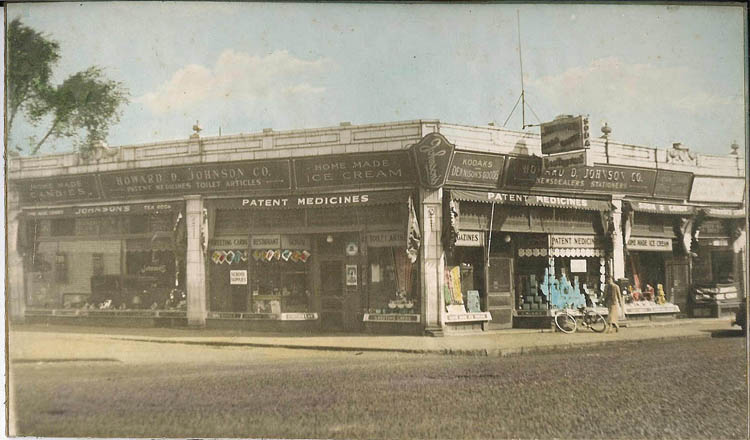
While walking to a friend's cookout in Quincy yesterday afternoon, I saw a granite marker near the Wollaston T stop on the Red Line. Turns out the that first Howard Johnson's ever was located in Quincy -- at the location of the marker on the edge of the T station's parking lot.


The marker reads:
Howard Johnson's -- or HoJo's, as my dad called it when I was a kid -- started out as a drug store and ice cream shop that branched out along the Massachusetts shore before expanding into roadside restaurants and eventually hotels. HoJo's even operated a vending machine business that sold branded pop, gum, and other items. At its peak, there were 1,000 locations, many of which will soon be gone. In 1985, Mariott bought Howard Johnson's and converted many of the restaurants into Roy Rogers.
Perhaps the most notable aspect of Howard Johnson's was its architecture, which combined the traditional New England colonial home with a bright orange roof to serve as a "beacon" for travelers.
Why is the T stop called Wollaston? In 1625, Captain Wollaston, among the area's first European settlers, cleared some land in what is now Quincy. Quincy was once part of Braintree but split from that city in 1792. Wollaston is considered a "section" of Quincy, which was named after John Quincy, a relative of Edmund Quincy, who has a colorful history.
Fascinating stuff for a Sunday afternoon!
The marker reads:
Site of the first Howard Johnson's store opened by Howard D. Johnson on September 3, 1925. This commemorative marker was erected by Howard Johnson's through the courtesy of the Massachusetts Bay Transportation Authority and the city of Quincy on January 11, 1972.
Howard Johnson's -- or HoJo's, as my dad called it when I was a kid -- started out as a drug store and ice cream shop that branched out along the Massachusetts shore before expanding into roadside restaurants and eventually hotels. HoJo's even operated a vending machine business that sold branded pop, gum, and other items. At its peak, there were 1,000 locations, many of which will soon be gone. In 1985, Mariott bought Howard Johnson's and converted many of the restaurants into Roy Rogers.
Perhaps the most notable aspect of Howard Johnson's was its architecture, which combined the traditional New England colonial home with a bright orange roof to serve as a "beacon" for travelers.
Why is the T stop called Wollaston? In 1625, Captain Wollaston, among the area's first European settlers, cleared some land in what is now Quincy. Quincy was once part of Braintree but split from that city in 1792. Wollaston is considered a "section" of Quincy, which was named after John Quincy, a relative of Edmund Quincy, who has a colorful history.
Fascinating stuff for a Sunday afternoon!
Friday, June 13, 2003
Ravaging Radio X
From the In Box: Magazine Me XXXV
In no particular order:
The Week (actually, this is my No. 1)
Entertainment Weekly
Fast Company (legit... not sucking up; that's how I got hooked to Media Diet.)
Mojo
Wizard
-- Mike Lally
***
Utne Reader
Smithsonian
ID
Natural Home
Fast Company (of course!)
Poets & Writers
-- Lynne Parson Mikhaeil
What are your favorite magazines? Let me know.
-- Mike Lally
-- Lynne Parson Mikhaeil
What are your favorite magazines? Let me know.
Rock Shows of Note LXVI
I am such a silly boy. After RealTime and two Anchormen shows at the end of last week -- one followed by a house party, even -- I've been sick as a dog this week. Stuffy head, runny nose, nagging cough. The whole shebang. I barely made it through the first day of the Weblog Business Strategies conference, and I'm just now starting to feel better. So one would think I've been taking it easy, right? Not really.
Take last night as an example. After leaving work and spending some time at home catching up on mail and magazines, I got the itch to go out around 9:30 p.m. when I should have been heading to bed. There was a Handstand Command showcase at the Choppin' Block, and I didn't want to miss Big Digits' first show with Mac Swell and TD performing together. So I left the house, hit the T, and made my way to Brigham Circle. I got to the club around 10:15 -- just after Big Digits' set ended. My whole motivation for going out was gone! I was super bummed, but everyone who was there tells me that they were great. Next time, gents.
Plunge into Death followed with their usual brand of goth drama hop, even though Jef seemed a little low energy. Dave did his best to keep the crowd amped, and his hair is just crazy these days. Mad flopping. Mac got his dance on in front of the duo and joined them for a couple of songs at the end of the set.
I took a break outside with some friends for much of Cathy Cathodic's set. I've seen her perform several times before, and if you like your hip hop somewhat enlightened and empowering, I'm sure you'll like Cathy's rhymes. But I made a point to be back inside for Travers' performance. He was shooting video at the closing party for Hi-Fi Records on Sunday, and I wanted to see how much of it was incorporated into whatever he was going to do.
And, oh, what he did. Three video projectors. A blank white backdrop ringing the stage. Several costume changes. I'm not sure how to describe his performance, but it involved video segments, some sketch comedy bits, several recurring characters, dancing, singing, and, oh, so much more. My favorite part was probably when he was performing with the fake band, the three other band members -- played by him -- projected on the walls around him, playing instruments, dancing, winking, and otherwise contributing to the performance. Parts reminded me slightly of Ze Frank. The menacing drummer hunched over the kit was a nice touch.
There were so many elements to his performance, so many transitions. It's well worth putting on again, if Travers is of the mind to do so. After his set ended, I lingered outside to get some air and started thinking about catching a cab home. I was pretty sure most of my friends had gone, but stepping inside to use the restroom before hailing a taxi, there was Jef and Dave! I was so lucky to catch a ride home with them, making it back to Magazine Street by, well, 3 a.m. or so to make a grilled cheese sandwich and finally collapse on the bed.
Needless to say, I was not up bright and early this morning. I did not wash the dishes last night. I did not do laundry. I did not take out the trash and recycling. I did not cut up the browning bananas to put them in the freezer to make smoothies. I did not get some much-needed rest to help heal and get over this cold. But even though I missed Big Digits, I did go to a Rock Show of Note.
One where most, if not all of the bands, used remote controls.
Take last night as an example. After leaving work and spending some time at home catching up on mail and magazines, I got the itch to go out around 9:30 p.m. when I should have been heading to bed. There was a Handstand Command showcase at the Choppin' Block, and I didn't want to miss Big Digits' first show with Mac Swell and TD performing together. So I left the house, hit the T, and made my way to Brigham Circle. I got to the club around 10:15 -- just after Big Digits' set ended. My whole motivation for going out was gone! I was super bummed, but everyone who was there tells me that they were great. Next time, gents.
Plunge into Death followed with their usual brand of goth drama hop, even though Jef seemed a little low energy. Dave did his best to keep the crowd amped, and his hair is just crazy these days. Mad flopping. Mac got his dance on in front of the duo and joined them for a couple of songs at the end of the set.
I took a break outside with some friends for much of Cathy Cathodic's set. I've seen her perform several times before, and if you like your hip hop somewhat enlightened and empowering, I'm sure you'll like Cathy's rhymes. But I made a point to be back inside for Travers' performance. He was shooting video at the closing party for Hi-Fi Records on Sunday, and I wanted to see how much of it was incorporated into whatever he was going to do.
And, oh, what he did. Three video projectors. A blank white backdrop ringing the stage. Several costume changes. I'm not sure how to describe his performance, but it involved video segments, some sketch comedy bits, several recurring characters, dancing, singing, and, oh, so much more. My favorite part was probably when he was performing with the fake band, the three other band members -- played by him -- projected on the walls around him, playing instruments, dancing, winking, and otherwise contributing to the performance. Parts reminded me slightly of Ze Frank. The menacing drummer hunched over the kit was a nice touch.
There were so many elements to his performance, so many transitions. It's well worth putting on again, if Travers is of the mind to do so. After his set ended, I lingered outside to get some air and started thinking about catching a cab home. I was pretty sure most of my friends had gone, but stepping inside to use the restroom before hailing a taxi, there was Jef and Dave! I was so lucky to catch a ride home with them, making it back to Magazine Street by, well, 3 a.m. or so to make a grilled cheese sandwich and finally collapse on the bed.
Needless to say, I was not up bright and early this morning. I did not wash the dishes last night. I did not do laundry. I did not take out the trash and recycling. I did not cut up the browning bananas to put them in the freezer to make smoothies. I did not get some much-needed rest to help heal and get over this cold. But even though I missed Big Digits, I did go to a Rock Show of Note.
One where most, if not all of the bands, used remote controls.
From the In Box: Weblog Business Strategies 2003
I've enjoyed your notes from various conferences very much. Thanks and keep up the good work! I hope you won't mind a few suggestions about making your conference coverage easier to read. I had a bit of trouble navigating, both just now for this Weblog Business Strategies conference and earlier with the GEL conference. I usually end up reading the conference notes soon after the conference ends, not real-time. I assume I'm not the only one who does so.
(1) Make it easier to find and track the conference postings. A page with links to all the conference entries would make it much easier to navigate. They're hard to find when they slip off the front page into the archives, and I also have trouble remembering which entries I've already read. I read entries in short bursts, sometimes out of order, and even if I'm reading them all in order I sometimes lose track as I'm scrolling the huge long pages. Unfortunately, Google doesn't work to find entries to this week's conference because it hasn't indexed the newest archive pages yet. I assume you can do this through MT categories instead.
(2) Your archive navigation would be easier if you (1) added the date to your post timestamps so one doesn't have to scroll back through many entries and thousands of words to find the date, (2) added a link to the archives up on top of your main page, not at the very bottom, and (3) changed the archive.html to reverse chronological order. I had the hardest time finding that link to your archives at the very bottom of your page when I was looking up the GEL conference, and then once I got there, I went to the 2001 archive by mistake.
You could add both links to the conference category page and the archive page up on the right sidebar by your review links.
Anyway, I hope you don't mind the suggestions. I realize the problem is always finding the spare time. I thought I'd send this off since you were doing such a great job transcribing these conferences. The transcripts are a great resource and a lot of people point to you, and I wanted to give you a heads up that some people may have trouble finding what they came to read. -- John Troyer
Keeping Track offers a nice index of my confblog reports.
(1) Make it easier to find and track the conference postings. A page with links to all the conference entries would make it much easier to navigate. They're hard to find when they slip off the front page into the archives, and I also have trouble remembering which entries I've already read. I read entries in short bursts, sometimes out of order, and even if I'm reading them all in order I sometimes lose track as I'm scrolling the huge long pages. Unfortunately, Google doesn't work to find entries to this week's conference because it hasn't indexed the newest archive pages yet. I assume you can do this through MT categories instead.
(2) Your archive navigation would be easier if you (1) added the date to your post timestamps so one doesn't have to scroll back through many entries and thousands of words to find the date, (2) added a link to the archives up on top of your main page, not at the very bottom, and (3) changed the archive.html to reverse chronological order. I had the hardest time finding that link to your archives at the very bottom of your page when I was looking up the GEL conference, and then once I got there, I went to the 2001 archive by mistake.
You could add both links to the conference category page and the archive page up on the right sidebar by your review links.
Anyway, I hope you don't mind the suggestions. I realize the problem is always finding the spare time. I thought I'd send this off since you were doing such a great job transcribing these conferences. The transcripts are a great resource and a lot of people point to you, and I wanted to give you a heads up that some people may have trouble finding what they came to read. -- John Troyer
Keeping Track offers a nice index of my confblog reports.
Corollary: Weblog Business Strategies 2003
Rebecca Lieb, executive editor of the interactive marketing channel for Jupitermedia's Internet.com, recaps the recent Weblog Business Strategies conference today.
Thursday, June 12, 2003
Clothes Whore VIII
Thanks to Nate Rock of Crap Log, Media Dieticians can now outfit themselves in the official Media Diet uniform. Show your independent media pride by donning the Media Diet-approved attire of thoughtful grassroots media makers everywhere. Or don't. But are you sure you should go out dressed like that? With Media Diet, the mantle is the message. Be proud, be loud, wear the shroud. OK, I think it's time to go home.
From the In Box: Magazine Me XXXV
I'd have to say:
Utne Reader
Newtype USA
Macworld
The Atlantic
-- Gregory Blake
What're yours? Let me know.
-- Gregory Blake
What're yours? Let me know.
Music to My Ears XXXVII
A five-pack of new record reviews!
Anberlin "Blueprints for the Black Market"
A hard rock-inspired alt.rock five piece, Anberlin propels a peppy approach to its music on this record. With a bizarrely dramatic Danny Elfman-like vocal delivery in sections of the opening track, "Ready Fuels," the Orlando, Florida-based band adds an almost Push Kings-esque doot-doot-doo-doo-doo sing-along bridge in "Foreign Languages." While I appreciate the band's power pop tendencies, the record's production values and the group's occasionally lackluster alt.rock leanings -- per the press sheet's comparisons to the Foo Fighters and Superdrag -- make this release whinily white bread. I'm sure the hard-rock heartthrob hoi polloi in middle America might find Anberlin's anthemic assumptions palatable -- especially given the CD insert's pinup-worthy photography and the band's too-true cover of the Cure's "Love Song" -- but I fear that there's not too much to their music. The drawn-out classic rock chorus in "Change the World (Lost Ones)" isn't overly convincing, and "Cold War Transmissions" brings in a bit of boringly radio-friendly blather. This consistency continues for the bulk of "Blueprints," and for the most part, the record rarely resonates with this reviewer. That said, "The Undeveloped Story" contains some promising progressions, and "Autobahn" and "We Dreamt in Heist" return to the Push Kings reminders. Regardless, Anberlin doesn't sustain the interesting sections or sequences enough to hold my attention. When the band's not too ashamed to revel in its unabashed power pop playfulness, Anberlin aspires to a goal worth attaining. But its hard rock approach to alt.rock falls flat, and it's really only the second half of the CD that shows any steady sensibility. I'm not sure I'll return to this for repeat listens. Tooth & Nail, P.O. Box 12698, Seattle, WA 98111.
Armor for Sleep "Dream to Make Believe"
I think I need to seek out more punk and no-wave records to review, because it seems Media Diet is starting to secure service by the more sleepy Sunday sad boy sing-along emo and melodic hardcore labels. Not that I don't appreciate receiving the records or enjoy listening to them, but so much of this style of music sounds the same to me and doesn't always demand repeated listens. Having toured with musical groups such as Thursday and Piebald, the four piece Armor for Sleep is cozily comfortable in the earnestly aggressive yet slightly prone to shoe gazing school of indie rock. "Being Your Walls," the fourth track, is the first song that really caught my attention, with a subtly cyclical and off-kilter song structure. Maybe it's the interwooven chorus or justifiably jagged guitar stabs. Maybe it's the little bit of hesitant herky jerk as the song builds to the end. The segue to "My Town"'s start and stop opening and its simple synth section maintains my interest, and this number encourages me to temper my initial dismissal and doubt somewhat. Not a bad song! "The Wanderers Guild" is a slight step backwards, but the record's rise to the occasion returns, and Armor for Sleep is redeemed by the increasingly intense "Front and Front Steps," an impressive slice-of-life snapshot. This is by far the best song I've heard on this. Whild the CD's closing four songs return to the band's more mellow meanderings, the lyrical content of "Raindrops" and "Kind of Perfect" beg some attention and analysis. The former adequately addresses how certain people in our lives can overwhelm, fill, and feed us. These are perhaps the hardest relationships to lose -- and the most frustrating unrequited loves. As satisfying as it can be to be submersed in and washed over by someone -- as sufficient as that unshared swelling can seem -- it almost always brings the corollary danger of drowning, self-dismissal, and self-denial. The penultimate piece, "Kind of Perfect," also hit me hard. Sometimes you just want someone in your life, to share your space, to settle in silently and soak up the collective experience of being together. In the next room. Silent on the other end of the phone line. Drifting off to dream. Singer and songwriter Ben Jorgensen captures the tension of passive and persistent presence and heartfelt hope, as well as the loss inherent in that longing. All in all, this record doesn't always share its strength in terms of song structure, but substantially, its content brooks no compromise. And to Jorgensen's emo credit, the last song "Slip Like Space" is an impressively intent statement of moving on and leaving behind, as bittersweet as that process and progress may be. Worth checking out. Equal Vision, P.O. Box 14, Hudson, NY 12534.
Fall Out Boy "Take This to Your Grave"
I am such a sucker for this sound. Ecstatically enthusiastic and melodically meaningful! I don't know if I'm prone to prefer pop punk or if I just like energy and intensity with my thoughtfully tuneful and hook-laden sing-along songs. But it's getting so, as interchangeable as some of these bands can be, I almost don't care, I'm such a big fan of the genre. Don't get me wrong, I'm not so far gone that I appreciate or even begin to understand the output and popularity of Blink-182, Sum-41, and their punk-by-the-numbers commercially complicit comrades. But a band like Fall Out Boy, being quite a different animal, is right up my alley. Coming from a monied suburb of Chicago, the band combines the maybe mopey but still hopeful emotionalism of bands like the Smoking Popes with the northern Californian clash and catchiness of the early Lookout roster, as well as some of the melodic grit and grin of the much-missed Underdog Records scene. After several blissfully beatific pop-punk numbers "Saturday" adds some disappointingly screamo backups just before some frightfully delightful falsetto. I wonder whether the band really thought that worked well -- or if both are indications that they don't take themselves too seriously. I like to think the latter, as the next track, "Homesick at Space Camp," is cheekily geeky at several levels. Fall Out Boy combines sugar-sweet songwriting with enough regional place dropping and existentially emotional energy that the end result almost evokes an equation. Plug this record into a computer, and I'm sure you'll come close to a recipe for radio play. Fueled by Ramen, P.O. Box 12563, Gainesville, FL 32604.
Shai Hulud "That Within Blood Ill-Tempered"
Now this is more like it! Unlike emo-leaning bands that adopt some semblance of screamo to elicit an edge, the four piece Shai Hulud avoids such aspirational adaptation and maintains a masculine melodicism amidst its acerbic aggression. Passionate to a point (as in pointed stick, not possibility or promise), this is heavy hardcore that still holds harmony as a value and a virtue. From the very first song, the verbosely titled "Scornful of the Motives and Virtue of Others," Shai Hulud erupts with mirthfully moshing metal and high-minded hardcore. The screamo, shouted vocals don't stick out as silly but instead solidifies Shai Hulud's seriousness. The second piece, "Let Us at Last Praise the Colonizers of Dreams," adds an amusing sing-along chorus that surprised me. Even in the thick of metal-tinged hardcore, Shai Hulud still manages to shout along in harmony. Brilliant! Turning to the lyric sheet, Shai Hulud impresses me with the depth and breadth of its inspirations and influences. Without coming across as cartoonily literary, the band draws on the work of Frank Herbert and J.R.R. Tolkien, composing almost operatic metal concept album-level lyrics while chalenging Johnny-come-lately bandwagon also rans. Truth be told, the album's design screams fantasy metal, but instead, Shai Hulud sheds light on what smart metal or intelligent hardcore might be. The band is aggressive without being assholes. Melodic without being mellow. Clever without being cloying. There is no inconsistency in terms of intensity song to song, and as far as this batch of reviews goes, Shai Hulud's new record is the most consistent, complex, and crucial record I've recently received. Given the band's brand of metallic hardcore and shouted singing, it's somewhat of a challenge to differentiate songs from one another, but the entire record holds together, the overall sound is impressively massive, and the words are worth watching. Even the end notes and thank you list highlights the band's heart, honor, and humor. Think Backstabbers Inc. with the sense of humor and politics of Propagandhi. Or Dillinger Four collaborating with Napalm Death. This is an excellent record that proves aggressive rock doesn't need to be cartoony or overly corrosive. Revelation Records, P.O. Box 5232, Huntington Beach, CA 92615.
Silverstein "When Broken Is Easily Fixed"
After a surprisingly screamo opening to the first song, "Smashed into Pieces," this south Ontario, Canada, five piece falls into a pleasantly aggressive melodic style that combines hardcore and emo. While the strained screamo parts tend to interrupt the effectively assertive melodic basis of the band's songwriting, the overall effect works surprisingly well. I just wish vocalist Shane Told could carry an angry, aggro line without resorting to all-out shouting. In fact, even in the second song, "Red Light Pledge," the guttural interruptions undermine what is otherwise a forceful emotional song. The band shows a sensitive side further with the introduction of strings under a plaintive spoke-word presentation. Do bands feel a need to break down into illegibility in order to claim hardcore credibility? The band adds a subtle nod to heavy metal fret work with the guitar work under the chorus to "Giving Up" -- a nice variation that's not too over the top until another screamo section. Not to continue the song by song, but in general, were Silverstein to find another mode of distraught or slightly distorted vocal delivery, their songs would really shine. Don't shy from your more sensitive side regardless of your metal and hardcore influences. As a side note, Victory's press sheet makes a point to mention that the band took its name from children's book author -- and countercultural freak -- Shel Silverstein. It's an interesting bit of trivia, but the influence doesn't carry across on the CD itself. Silverstein possesses neither the writer's innocent bliss a la Where the Sidewalk Ends nor his more adult-oriented hippie hullaballoo such as "Freakin' at the Freaker's Ball," opting instead for forcefully forlorn songs about love and loss. Regardless, Silverstein does provide a promising brand of emotional hardcore that wins at its most melodic and only suffers slightly when the band lapses into lazy yelling. "The Weak and the Wounded" stands out as a piece with potential, and if the band considered a more herky-jerky angular approach to its song structure, it might not need the back-and-forth screamo to maintain its energy and direction. A closing tip of the Media Diet hat to Martin Wittfooth, whose artwork adds a lot to the overall packaging. Victory Records, 346 N. Justine St. #504, Chicago, IL 60607.
Anberlin "Blueprints for the Black Market"
A hard rock-inspired alt.rock five piece, Anberlin propels a peppy approach to its music on this record. With a bizarrely dramatic Danny Elfman-like vocal delivery in sections of the opening track, "Ready Fuels," the Orlando, Florida-based band adds an almost Push Kings-esque doot-doot-doo-doo-doo sing-along bridge in "Foreign Languages." While I appreciate the band's power pop tendencies, the record's production values and the group's occasionally lackluster alt.rock leanings -- per the press sheet's comparisons to the Foo Fighters and Superdrag -- make this release whinily white bread. I'm sure the hard-rock heartthrob hoi polloi in middle America might find Anberlin's anthemic assumptions palatable -- especially given the CD insert's pinup-worthy photography and the band's too-true cover of the Cure's "Love Song" -- but I fear that there's not too much to their music. The drawn-out classic rock chorus in "Change the World (Lost Ones)" isn't overly convincing, and "Cold War Transmissions" brings in a bit of boringly radio-friendly blather. This consistency continues for the bulk of "Blueprints," and for the most part, the record rarely resonates with this reviewer. That said, "The Undeveloped Story" contains some promising progressions, and "Autobahn" and "We Dreamt in Heist" return to the Push Kings reminders. Regardless, Anberlin doesn't sustain the interesting sections or sequences enough to hold my attention. When the band's not too ashamed to revel in its unabashed power pop playfulness, Anberlin aspires to a goal worth attaining. But its hard rock approach to alt.rock falls flat, and it's really only the second half of the CD that shows any steady sensibility. I'm not sure I'll return to this for repeat listens. Tooth & Nail, P.O. Box 12698, Seattle, WA 98111.
Armor for Sleep "Dream to Make Believe"
I think I need to seek out more punk and no-wave records to review, because it seems Media Diet is starting to secure service by the more sleepy Sunday sad boy sing-along emo and melodic hardcore labels. Not that I don't appreciate receiving the records or enjoy listening to them, but so much of this style of music sounds the same to me and doesn't always demand repeated listens. Having toured with musical groups such as Thursday and Piebald, the four piece Armor for Sleep is cozily comfortable in the earnestly aggressive yet slightly prone to shoe gazing school of indie rock. "Being Your Walls," the fourth track, is the first song that really caught my attention, with a subtly cyclical and off-kilter song structure. Maybe it's the interwooven chorus or justifiably jagged guitar stabs. Maybe it's the little bit of hesitant herky jerk as the song builds to the end. The segue to "My Town"'s start and stop opening and its simple synth section maintains my interest, and this number encourages me to temper my initial dismissal and doubt somewhat. Not a bad song! "The Wanderers Guild" is a slight step backwards, but the record's rise to the occasion returns, and Armor for Sleep is redeemed by the increasingly intense "Front and Front Steps," an impressive slice-of-life snapshot. This is by far the best song I've heard on this. Whild the CD's closing four songs return to the band's more mellow meanderings, the lyrical content of "Raindrops" and "Kind of Perfect" beg some attention and analysis. The former adequately addresses how certain people in our lives can overwhelm, fill, and feed us. These are perhaps the hardest relationships to lose -- and the most frustrating unrequited loves. As satisfying as it can be to be submersed in and washed over by someone -- as sufficient as that unshared swelling can seem -- it almost always brings the corollary danger of drowning, self-dismissal, and self-denial. The penultimate piece, "Kind of Perfect," also hit me hard. Sometimes you just want someone in your life, to share your space, to settle in silently and soak up the collective experience of being together. In the next room. Silent on the other end of the phone line. Drifting off to dream. Singer and songwriter Ben Jorgensen captures the tension of passive and persistent presence and heartfelt hope, as well as the loss inherent in that longing. All in all, this record doesn't always share its strength in terms of song structure, but substantially, its content brooks no compromise. And to Jorgensen's emo credit, the last song "Slip Like Space" is an impressively intent statement of moving on and leaving behind, as bittersweet as that process and progress may be. Worth checking out. Equal Vision, P.O. Box 14, Hudson, NY 12534.
Fall Out Boy "Take This to Your Grave"
I am such a sucker for this sound. Ecstatically enthusiastic and melodically meaningful! I don't know if I'm prone to prefer pop punk or if I just like energy and intensity with my thoughtfully tuneful and hook-laden sing-along songs. But it's getting so, as interchangeable as some of these bands can be, I almost don't care, I'm such a big fan of the genre. Don't get me wrong, I'm not so far gone that I appreciate or even begin to understand the output and popularity of Blink-182, Sum-41, and their punk-by-the-numbers commercially complicit comrades. But a band like Fall Out Boy, being quite a different animal, is right up my alley. Coming from a monied suburb of Chicago, the band combines the maybe mopey but still hopeful emotionalism of bands like the Smoking Popes with the northern Californian clash and catchiness of the early Lookout roster, as well as some of the melodic grit and grin of the much-missed Underdog Records scene. After several blissfully beatific pop-punk numbers "Saturday" adds some disappointingly screamo backups just before some frightfully delightful falsetto. I wonder whether the band really thought that worked well -- or if both are indications that they don't take themselves too seriously. I like to think the latter, as the next track, "Homesick at Space Camp," is cheekily geeky at several levels. Fall Out Boy combines sugar-sweet songwriting with enough regional place dropping and existentially emotional energy that the end result almost evokes an equation. Plug this record into a computer, and I'm sure you'll come close to a recipe for radio play. Fueled by Ramen, P.O. Box 12563, Gainesville, FL 32604.
Shai Hulud "That Within Blood Ill-Tempered"
Now this is more like it! Unlike emo-leaning bands that adopt some semblance of screamo to elicit an edge, the four piece Shai Hulud avoids such aspirational adaptation and maintains a masculine melodicism amidst its acerbic aggression. Passionate to a point (as in pointed stick, not possibility or promise), this is heavy hardcore that still holds harmony as a value and a virtue. From the very first song, the verbosely titled "Scornful of the Motives and Virtue of Others," Shai Hulud erupts with mirthfully moshing metal and high-minded hardcore. The screamo, shouted vocals don't stick out as silly but instead solidifies Shai Hulud's seriousness. The second piece, "Let Us at Last Praise the Colonizers of Dreams," adds an amusing sing-along chorus that surprised me. Even in the thick of metal-tinged hardcore, Shai Hulud still manages to shout along in harmony. Brilliant! Turning to the lyric sheet, Shai Hulud impresses me with the depth and breadth of its inspirations and influences. Without coming across as cartoonily literary, the band draws on the work of Frank Herbert and J.R.R. Tolkien, composing almost operatic metal concept album-level lyrics while chalenging Johnny-come-lately bandwagon also rans. Truth be told, the album's design screams fantasy metal, but instead, Shai Hulud sheds light on what smart metal or intelligent hardcore might be. The band is aggressive without being assholes. Melodic without being mellow. Clever without being cloying. There is no inconsistency in terms of intensity song to song, and as far as this batch of reviews goes, Shai Hulud's new record is the most consistent, complex, and crucial record I've recently received. Given the band's brand of metallic hardcore and shouted singing, it's somewhat of a challenge to differentiate songs from one another, but the entire record holds together, the overall sound is impressively massive, and the words are worth watching. Even the end notes and thank you list highlights the band's heart, honor, and humor. Think Backstabbers Inc. with the sense of humor and politics of Propagandhi. Or Dillinger Four collaborating with Napalm Death. This is an excellent record that proves aggressive rock doesn't need to be cartoony or overly corrosive. Revelation Records, P.O. Box 5232, Huntington Beach, CA 92615.
Silverstein "When Broken Is Easily Fixed"
After a surprisingly screamo opening to the first song, "Smashed into Pieces," this south Ontario, Canada, five piece falls into a pleasantly aggressive melodic style that combines hardcore and emo. While the strained screamo parts tend to interrupt the effectively assertive melodic basis of the band's songwriting, the overall effect works surprisingly well. I just wish vocalist Shane Told could carry an angry, aggro line without resorting to all-out shouting. In fact, even in the second song, "Red Light Pledge," the guttural interruptions undermine what is otherwise a forceful emotional song. The band shows a sensitive side further with the introduction of strings under a plaintive spoke-word presentation. Do bands feel a need to break down into illegibility in order to claim hardcore credibility? The band adds a subtle nod to heavy metal fret work with the guitar work under the chorus to "Giving Up" -- a nice variation that's not too over the top until another screamo section. Not to continue the song by song, but in general, were Silverstein to find another mode of distraught or slightly distorted vocal delivery, their songs would really shine. Don't shy from your more sensitive side regardless of your metal and hardcore influences. As a side note, Victory's press sheet makes a point to mention that the band took its name from children's book author -- and countercultural freak -- Shel Silverstein. It's an interesting bit of trivia, but the influence doesn't carry across on the CD itself. Silverstein possesses neither the writer's innocent bliss a la Where the Sidewalk Ends nor his more adult-oriented hippie hullaballoo such as "Freakin' at the Freaker's Ball," opting instead for forcefully forlorn songs about love and loss. Regardless, Silverstein does provide a promising brand of emotional hardcore that wins at its most melodic and only suffers slightly when the band lapses into lazy yelling. "The Weak and the Wounded" stands out as a piece with potential, and if the band considered a more herky-jerky angular approach to its song structure, it might not need the back-and-forth screamo to maintain its energy and direction. A closing tip of the Media Diet hat to Martin Wittfooth, whose artwork adds a lot to the overall packaging. Victory Records, 346 N. Justine St. #504, Chicago, IL 60607.
Digesting the Daily XV
Recent editions of the Daily Northwestern, the student newspaper of my alma mater, featured several media-, technology-, and activism-related items that might be of interest to Media Dieticians.
Chicago Poet Is a Music Scene Staple
Bard got his start traveling with Guided By Voices and now introduces bands at clubs all over the city
(May 21, 2003)
An Alternative to Corporate Insensitivity
NU alumna, Evanston resident Marci Koblenz founds nonprofit organization for Companies That Care
(May 22, 2003)
The Best Medicine
All joking aside, Laff-In, a senior citizen comedy troupe, uses humor to build relationships, heal painful pasts
(May 23, 2003)
If you work for a college newspaper and would like to sign me up for a complimentary subscription, please feel free to do so. My address is in the grey bar over on the left.
Chicago Poet Is a Music Scene Staple
Bard got his start traveling with Guided By Voices and now introduces bands at clubs all over the city
(May 21, 2003)
An Alternative to Corporate Insensitivity
NU alumna, Evanston resident Marci Koblenz founds nonprofit organization for Companies That Care
(May 22, 2003)
The Best Medicine
All joking aside, Laff-In, a senior citizen comedy troupe, uses humor to build relationships, heal painful pasts
(May 23, 2003)
If you work for a college newspaper and would like to sign me up for a complimentary subscription, please feel free to do so. My address is in the grey bar over on the left.
Corollary: Magazine Me XXXV
Since October 2002, Folio magazine has been running a column called "A Great One Remembered" that recalls long-lost magazines. To date they've looked at
Mobster Times
Avant Garde
7 Days
Look
Saturday Review
Southern Magazine
Casket and Sunnyside
Scanlan's Monthly
True
It's one of my favorite parts of the magazine.
It's one of my favorite parts of the magazine.
NetWork VII
PowerMingle, a second-string online network for business people, has introduce a new service: TravelMatch.
Personally, I think I'd rather just search for folks in the places I'm going to go to -- instead of having random matches made based on short-term same time-same place proximity -- but it's an intriguing idea. This can be used to find locals, but it can also be used to connect with other business travelers who happen to be in the same location you are.
Next time you travel to another city, Powermingle's TravelMatch service will introduce you to other professionals who live there or who are passing through at the same time as you.
Personally, I think I'd rather just search for folks in the places I'm going to go to -- instead of having random matches made based on short-term same time-same place proximity -- but it's an intriguing idea. This can be used to find locals, but it can also be used to connect with other business travelers who happen to be in the same location you are.
Hiking History IV
It's rare that a Web site makes me want to pack a bag, hop on a plane or train, and actually go somewhere to explore the site, well, on site. But Bridges and Tunnels of Allegheny County and Pittsburgh, PA and Built St. Louis inspire me to do just that. The sites don't have all of the elements of what I've been thinking about as mapblogging, but they're close.
Bridges and Tunnels lets you sort the resources by location and use, and includes a good amount of engineering and construction terminology and information. Built St. Louis is "dedicated to the historic architecture" of that city, featuring crumbling landmarks, revitalized structures, lost buildings, and architectural anachronisms. The site also offers neighborhood-based tours of various structures, such as those on the north side, bringing us even closer to mapblogging.
Hiptop in hand, hit the streets!
Thanks to Metafilter.
Bridges and Tunnels lets you sort the resources by location and use, and includes a good amount of engineering and construction terminology and information. Built St. Louis is "dedicated to the historic architecture" of that city, featuring crumbling landmarks, revitalized structures, lost buildings, and architectural anachronisms. The site also offers neighborhood-based tours of various structures, such as those on the north side, bringing us even closer to mapblogging.
Hiptop in hand, hit the streets!
Thanks to Metafilter.
Magazine Me XXXV
The Chicago Tribune published today a collectively written list of what they consider the 50 best magazines. I was somewhat saddened that one of my favorite magazines -- Fast Company, natch -- didn't make the cut, but it was nice to see some lesser knowns such as Mojo, Reason, Dwell, Metropolis, and Trains get their due.
Jessa Crispin comments on the roundup, as does The Minor Fall, the Major Lift. Both responses beg the question: What's on your list of favorite magazines? Rather than decry other folks' best-of lists, make your own.
In fact, let's do just that. I'll noodle some on my favorite mags, but, hey, Media Dieticians, what are your favorite magazines? Let me know.
Thanks to I Want Media.
Jessa Crispin comments on the roundup, as does The Minor Fall, the Major Lift. Both responses beg the question: What's on your list of favorite magazines? Rather than decry other folks' best-of lists, make your own.
In fact, let's do just that. I'll noodle some on my favorite mags, but, hey, Media Dieticians, what are your favorite magazines? Let me know.
Thanks to I Want Media.
Corollary: Weblog Business Strategies 2003
I'm quoted in a piece by Mark Glaser in Online Journalism Review today.
From the In Box: Weblog Business Strategies 2003
I was interested in your mention of the real-time note taking at conferences. Two thoughts: One is that you should get paid for this -- by the conference if by no one else. The second is that legal recorders can probably do this as well for anyone who is interested -- they take basically real-time notes of trial proceedings. -- Owen Linderholm
Wednesday, June 11, 2003
Postlude: Weblog Business Strategies 2003
I'm not going to do too much in the way of sensemaking in the aftermath of the Weblog Business Strategies conference because I don't want to take the time to reread all of my reports, identify consistent threads, or make conclusions. But I do have some post-conference extemporizing to do.
For the most part, I'm struck by the parallels between the current conversation about blogs and discussions about the state of zinemaking in the mid-'90s. When the mainstream media latched onto zine culture in 1994 and 1995, many of the same questions people are asking about blogs came up in the grassroots print media community. What's a zine? Is it "zine" or "'zine"? (I was one person who thought that the apostrophe wasn't necessary and overly relegated zines to second-class status in relation to magazines. Silly me.) Are zinemakers journalists? Will zines overtake or create a valid media space parallel to magazines?
We didn't answer those questions about zines, and I'm not sure we'll ever answer them about blogs. You see, zines have carried on. The mainstream attention faded, and zines fell back into their quaint little underground. That's not a bad thing. And in many ways, blogs are the new zines. Or e-zines. The parallels are there. While I think blogs have a better chance of walking hand in hand with other widespread forms of Web publishing, communication, and culture, I am bored to tears by questions like "What's a blog?" and "Are bloggers journalists?" (I'm also slightly amused by folks who insist on calling them Weblogs instead of blogs. Tool preference aside, blogs are native to the Web. So why say "Web"? 'Course, I also argued against the term "e-zine," so there we go.)
The subtle difference between Jason Shellen's question -- "Does anyone want us to tell you what a blog is?" -- and Dave Winer's refinement -- "Does anyone care what a blog is?" -- is an important distinction but, in the end, is somewhat moot. Defining and categorizing often leads to restriction and gradual atrophy. In the zine world 10 years ago, we had discussions about reviewzines, perzines, e-zines, megazines, metazines and the like. If you have ads in your zine, have you sold out? Who cares? Blogs already have increasingly limiting strictures imposed on them -- their linear, reverse chronological order, for two -- and I think it's less important to ask what a blog is than it is to ask what you do with your blog.
That said, I think that there's one important difference between the current state of blogging and the 1994-stylee state of zinemaking. In the zine scene, we saw a handful of "A-list" zinemakers emerge as more professional writers and editors -- and published book authors -- because of their self-publishing. Seth Friedman, Chip Rowe, Pagan Kennedy, and others got book deals because of their zines. Zinemakers got mersh journalism jobs because of the skills they honed in grassroots media work. However, while we saw a lot of mainstream media attention paid to zines -- "Isn't that cute? The kids are making little magazines!" -- we did not see professional journalists dipping their toes into the zine world. The talent flow was one way.
In blogging, the talent flow is two way, and I think some people feel threatened by that. Just like the zinemakers of a decade ago, some bloggers may be able to better themselves professionally because of their blogging. In addition, mainstream journalists and other professionals see value in participating in the blogosphere themselves. In the zine scene, we saw a lot of wannabe, second-wave zinemakers who started wading in the DIY waters because of mainstream media coverage, but we did not see the professionals wetting their toes. We groused about the "less pure" zines that were made by folks who started self-publishing because they wanted to do a zine -- rather than because they had something important they needed to say -- just as that topic comes up in the blogosphere (and in online communities and in...).
But we didn't have to contend with mainstream media makers and business people playing in our sandbox. Here, we have the opportunity to be what Carl Steadman calls microstars. Just as folks do in indie rock, minicomics, and other creative subcultures. And I think some of us feel threatened by big-name media makers and business people elbowing their way into our comfortable little commune. Likewise, we bristle because, as "pioneers," we feel that they're co-opting what we do -- or doing something that's less pure, idealistic, or whatever. That's because there are business opportunities in blogs. There aren't in zines.
Tony Perkins is not the anti-Christ. Regardless of whether he's using the term "blog" correctly -- when AlwaysOn launched, everything was a blog: articles, comments, discussion forum posts -- what he's doing is laudable and has promise. It's even bringing increased attention to our "more pure" blogging. I'm not sure whether folks get uppity because he is commercializing an aspect of blogging... or because reporters call him for blog-related interviews instead of our A-list microstars... but in the end, while AlwaysOn is not in and of itself a blog, part of AlwaysOn is a blog. And I think Perkins would be wise to up the ante on that front. (Clue: Give every AlwaysOn member their own personal, dedicated blog. Cull the best and brightest entries and give them front-page play. Take a page from Howard Rheingold's Electric Minds playbook. Clue two: Give participants ownership of what they write. Only that way will you attract the bloggers and members you really want.)
Debate is healthy. But let's not let it lead to inaction. Or factionalization. I think mainstream media and business attention is a good thing for blogging, bloggers, and blogs. I think it's good that Perkins is trying to wrap his head around it. (Although we had him at a bit of a disadvantage yesterday, and I don't think he needed to submit to Winer so quickly.) Instead of niching blogs as something that need to be created by an individual, not edited, and not commercial, lets look at ways blogging can fit into other aspects of Web publishing and Net-based communication. Because it can.
Zines couldn't.
For the most part, I'm struck by the parallels between the current conversation about blogs and discussions about the state of zinemaking in the mid-'90s. When the mainstream media latched onto zine culture in 1994 and 1995, many of the same questions people are asking about blogs came up in the grassroots print media community. What's a zine? Is it "zine" or "'zine"? (I was one person who thought that the apostrophe wasn't necessary and overly relegated zines to second-class status in relation to magazines. Silly me.) Are zinemakers journalists? Will zines overtake or create a valid media space parallel to magazines?
We didn't answer those questions about zines, and I'm not sure we'll ever answer them about blogs. You see, zines have carried on. The mainstream attention faded, and zines fell back into their quaint little underground. That's not a bad thing. And in many ways, blogs are the new zines. Or e-zines. The parallels are there. While I think blogs have a better chance of walking hand in hand with other widespread forms of Web publishing, communication, and culture, I am bored to tears by questions like "What's a blog?" and "Are bloggers journalists?" (I'm also slightly amused by folks who insist on calling them Weblogs instead of blogs. Tool preference aside, blogs are native to the Web. So why say "Web"? 'Course, I also argued against the term "e-zine," so there we go.)
The subtle difference between Jason Shellen's question -- "Does anyone want us to tell you what a blog is?" -- and Dave Winer's refinement -- "Does anyone care what a blog is?" -- is an important distinction but, in the end, is somewhat moot. Defining and categorizing often leads to restriction and gradual atrophy. In the zine world 10 years ago, we had discussions about reviewzines, perzines, e-zines, megazines, metazines and the like. If you have ads in your zine, have you sold out? Who cares? Blogs already have increasingly limiting strictures imposed on them -- their linear, reverse chronological order, for two -- and I think it's less important to ask what a blog is than it is to ask what you do with your blog.
That said, I think that there's one important difference between the current state of blogging and the 1994-stylee state of zinemaking. In the zine scene, we saw a handful of "A-list" zinemakers emerge as more professional writers and editors -- and published book authors -- because of their self-publishing. Seth Friedman, Chip Rowe, Pagan Kennedy, and others got book deals because of their zines. Zinemakers got mersh journalism jobs because of the skills they honed in grassroots media work. However, while we saw a lot of mainstream media attention paid to zines -- "Isn't that cute? The kids are making little magazines!" -- we did not see professional journalists dipping their toes into the zine world. The talent flow was one way.
In blogging, the talent flow is two way, and I think some people feel threatened by that. Just like the zinemakers of a decade ago, some bloggers may be able to better themselves professionally because of their blogging. In addition, mainstream journalists and other professionals see value in participating in the blogosphere themselves. In the zine scene, we saw a lot of wannabe, second-wave zinemakers who started wading in the DIY waters because of mainstream media coverage, but we did not see the professionals wetting their toes. We groused about the "less pure" zines that were made by folks who started self-publishing because they wanted to do a zine -- rather than because they had something important they needed to say -- just as that topic comes up in the blogosphere (and in online communities and in...).
But we didn't have to contend with mainstream media makers and business people playing in our sandbox. Here, we have the opportunity to be what Carl Steadman calls microstars. Just as folks do in indie rock, minicomics, and other creative subcultures. And I think some of us feel threatened by big-name media makers and business people elbowing their way into our comfortable little commune. Likewise, we bristle because, as "pioneers," we feel that they're co-opting what we do -- or doing something that's less pure, idealistic, or whatever. That's because there are business opportunities in blogs. There aren't in zines.
Tony Perkins is not the anti-Christ. Regardless of whether he's using the term "blog" correctly -- when AlwaysOn launched, everything was a blog: articles, comments, discussion forum posts -- what he's doing is laudable and has promise. It's even bringing increased attention to our "more pure" blogging. I'm not sure whether folks get uppity because he is commercializing an aspect of blogging... or because reporters call him for blog-related interviews instead of our A-list microstars... but in the end, while AlwaysOn is not in and of itself a blog, part of AlwaysOn is a blog. And I think Perkins would be wise to up the ante on that front. (Clue: Give every AlwaysOn member their own personal, dedicated blog. Cull the best and brightest entries and give them front-page play. Take a page from Howard Rheingold's Electric Minds playbook. Clue two: Give participants ownership of what they write. Only that way will you attract the bloggers and members you really want.)
Debate is healthy. But let's not let it lead to inaction. Or factionalization. I think mainstream media and business attention is a good thing for blogging, bloggers, and blogs. I think it's good that Perkins is trying to wrap his head around it. (Although we had him at a bit of a disadvantage yesterday, and I don't think he needed to submit to Winer so quickly.) Instead of niching blogs as something that need to be created by an individual, not edited, and not commercial, lets look at ways blogging can fit into other aspects of Web publishing and Net-based communication. Because it can.
Zines couldn't.
From the In Box: Weblog Business Strategies 2003
Saw your blog on the Jupiter blogging conference and I was blown away. I was there covering it for Econtent Magazine and took copious notes for two days when all I needed to do was go to your blog. Who knew?
What I want to know is how you were able to capture the exact content word for word? What did you use for a tool?
I take notes and record all my interviews. My goal has always been to tape and than translate the transcription into text and avoid the notes backup which interferes with my ability to listen and to carry on a coherent train of thought during the interview. Unfortunately, I've never been able to find decent speech recognition software to achieve this goal. They all require training, which I can do for myself but not for every different interview subject.
You seem to have found a way to capture the text verbatim. I know of no one who can type with this type of accuracy so I'm assuming you have a tool to capture and translate text on the fly. If you do, I would be grateful if you would share your toolset with me. -- Ron Miller
I wish I could help! It's just that I type really, really fast. So fast, in fact, that I'm able to capture near-verbatim, real-time transcripts of conference sessions and talks. I call this confblogging, and my approach -- the almost-full transcription method -- resulted from some confblogging I did at South by Southwest earlier this year. I didn't want to compete with Cory Doctorow's more impressionistic, outline-oriented approach to note taking, and I decided to err on the side of more rather than less. People seem to appreciate it.
Anil Dash mentioned something interesting at the Weblog Business Strategies conference. There were a lot of people blogging the event, and in addition to people commenting on the conference as the days went on, folks such as Denise Howell and Donna Wentworth were also capturing relatively complete records of the proceedings. Anil said that for the most part, Denise and I were neck to neck in the earlier portions of presentations and panels -- and that as talks progressed, it was intriguing to see where our attentions waxed and waned. I haven't compared our reports, but for a more complete picture of what went down, you might want to read Media Diet, Denise, and Donna in parallel. My guess is that together, we produced an almost-verbatim record of the event.
While I have no idea how fast I type, even, I'm quite enamored by the idea of confblogging. It creates a valuable archive of speeches and conversations that would be lost otherwise, and it seems to provide a valuable service to people who couldn't make it to a conference. I received several emails from people who were following the event from afar solely by refreshing their page view of Media Diet. That's pretty darn cool. And it's a nice bit of egoboo for this B-list blogger.
Media Dieticians might also be interested in my confblog of Fast Company's recent RealTime gathering.
What I want to know is how you were able to capture the exact content word for word? What did you use for a tool?
I take notes and record all my interviews. My goal has always been to tape and than translate the transcription into text and avoid the notes backup which interferes with my ability to listen and to carry on a coherent train of thought during the interview. Unfortunately, I've never been able to find decent speech recognition software to achieve this goal. They all require training, which I can do for myself but not for every different interview subject.
You seem to have found a way to capture the text verbatim. I know of no one who can type with this type of accuracy so I'm assuming you have a tool to capture and translate text on the fly. If you do, I would be grateful if you would share your toolset with me. -- Ron Miller
I wish I could help! It's just that I type really, really fast. So fast, in fact, that I'm able to capture near-verbatim, real-time transcripts of conference sessions and talks. I call this confblogging, and my approach -- the almost-full transcription method -- resulted from some confblogging I did at South by Southwest earlier this year. I didn't want to compete with Cory Doctorow's more impressionistic, outline-oriented approach to note taking, and I decided to err on the side of more rather than less. People seem to appreciate it.
Anil Dash mentioned something interesting at the Weblog Business Strategies conference. There were a lot of people blogging the event, and in addition to people commenting on the conference as the days went on, folks such as Denise Howell and Donna Wentworth were also capturing relatively complete records of the proceedings. Anil said that for the most part, Denise and I were neck to neck in the earlier portions of presentations and panels -- and that as talks progressed, it was intriguing to see where our attentions waxed and waned. I haven't compared our reports, but for a more complete picture of what went down, you might want to read Media Diet, Denise, and Donna in parallel. My guess is that together, we produced an almost-verbatim record of the event.
While I have no idea how fast I type, even, I'm quite enamored by the idea of confblogging. It creates a valuable archive of speeches and conversations that would be lost otherwise, and it seems to provide a valuable service to people who couldn't make it to a conference. I received several emails from people who were following the event from afar solely by refreshing their page view of Media Diet. That's pretty darn cool. And it's a nice bit of egoboo for this B-list blogger.
Media Dieticians might also be interested in my confblog of Fast Company's recent RealTime gathering.
The Best of the Web IV
The winners of the 2003 Webby Awards have been announced. Full disclosure: I was a nominating judge for the community category. You can read a transcript of Howard Rheingold's speech online, as well as all of the winners' acceptance speeches. Congratulations and kudos to all involved!
Subscribe to:
Posts (Atom)


 Posts
Posts